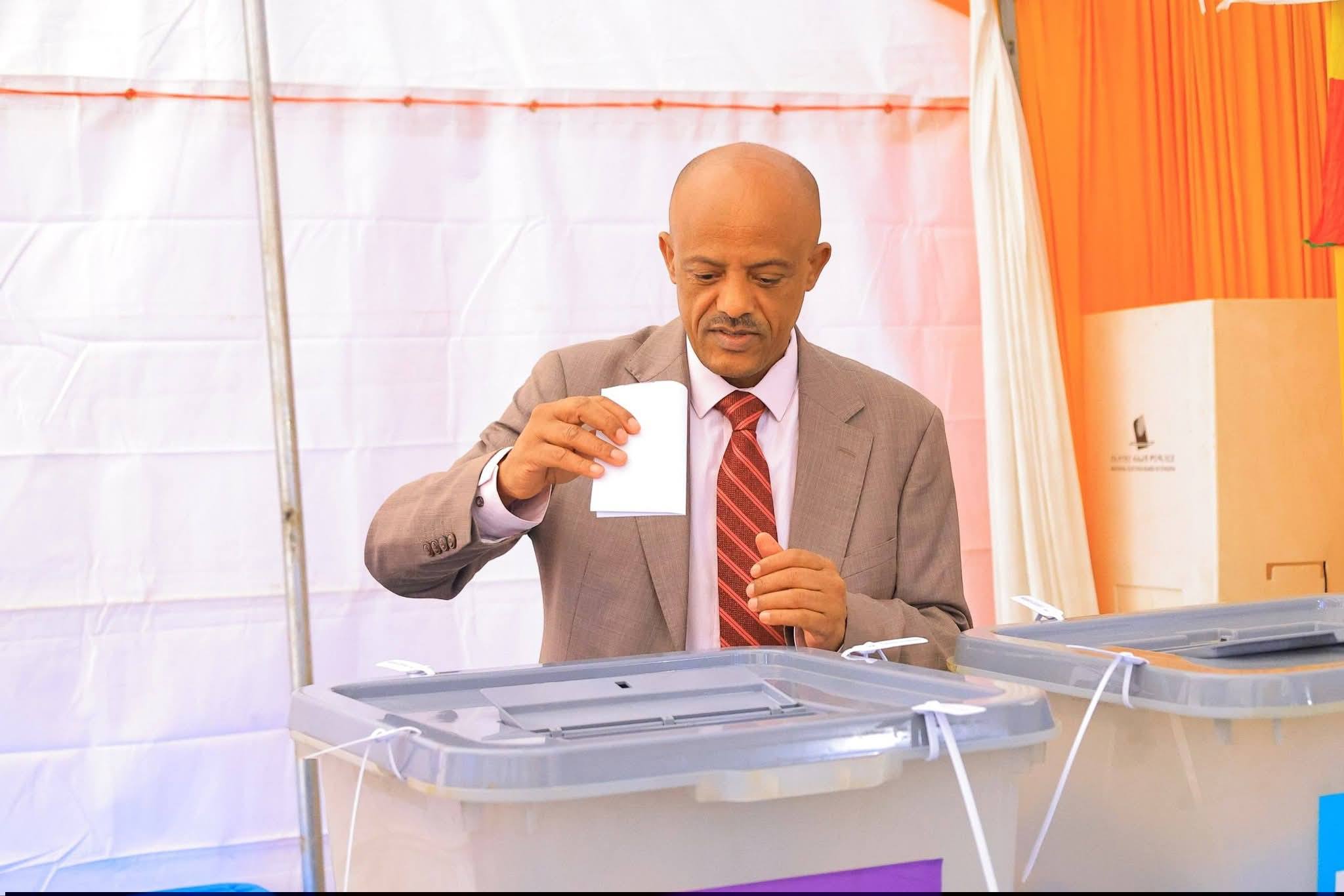
BAHIR DAR, ETHIOPIA – Arega Kebede, President of the Amhara Regional State, has described the ongoing election in Bahir Dar as a clear expression of popular sovereignty, saying high voter turnout demonstrates growing public confidence in elections as the basis of political legitimacy.
Speaking after casting his vote at a polling station in Gish Abay sub city, Arega said citizens were arriving in large numbers from surrounding neighborhoods, forming long queues that reflected strong engagement with the electoral process.
“We are currently voting in Bahir Dar city, specifically in the Gish Abay sub city,” he said. “As you can see, the people are voting in lines, and there has been a very high turnout of people coming from their neighborhoods to the polling stations.”
He added that the level of participation observed at the polling station signals increased public attention to national political processes.
“I have observed that this election has seen mass participation at this polling station, which indicates the high level of attention the public is giving to the electoral process,” he said.
Elections as a foundation of democratic governance
Arega emphasized that elections remain central to Ethiopia’s democratic development, noting that the country is still in the process of consolidating its democratic institutions.
“Conducting elections in our country is of great significance, especially since we are a developing democracy,” he said. “Elections are one of the primary foundations of democracy.”
He further stated that international assessments of democratic systems often rely on electoral processes as a key benchmark.
“The form of democracy expressed through elections is one of the criteria used internationally to judge whether democracy exists within a country,” he said. “Therefore, establishing a government elected by the people is crucial in Ethiopia.”
According to him, Ethiopia’s democratic system remains in a formative stage, making the current election particularly important for institutional development.
“Our overall democratic practice is that of a developing nation and not yet mature,” he said. “This election plays a vital role in helping democracy flourish further.”
Breaking a historical cycle of force
Reflecting on Ethiopia’s political history, Arega said state power has often been determined through force rather than democratic consent, a pattern he argued must be changed through sustained electoral practice.
“Government power in our country has mostly originated from the barrel of a gun and force, rather than from the voice of the people,” he said. “This election serves to break that cycle and ensure that governments are formed only through the popular vote.”
He said the electoral process is intended to achieve two main outcomes, the consolidation of civilian rule and the rejection of transitional governance models that undermine long term stability.
“This process confirms that power is held through the people’s voice rather than through weapons,” he said. “It also addresses those, both at home and abroad, who have long desired a transitional government for Ethiopia.”
Arega warned that repeated transitions would weaken institutional continuity and delay democratic consolidation.
“If Ethiopia is constantly passing through transitional governments, it will never have a stable government or a lasting system,” he said. “The only way to establish a popular and legal government is through the voice of the people via elections.”
Public participation as a source of legitimacy
Arega concluded that the meaning of the election extends beyond individual participation, framing it as a collective affirmation of state legitimacy derived from citizens.
“Today is not just about us voting as individuals,” he said. “When the community participates in this manner, it confirms that state power originates from the people and that a stable, popular government can only exist through their voice.”
He expressed satisfaction at participating in the vote alongside other citizens, describing the moment as a positive reflection of democratic engagement in the region.
“For my part, I am very happy that I was able to vote and that the rest of the public is able to vote as well,” he said.