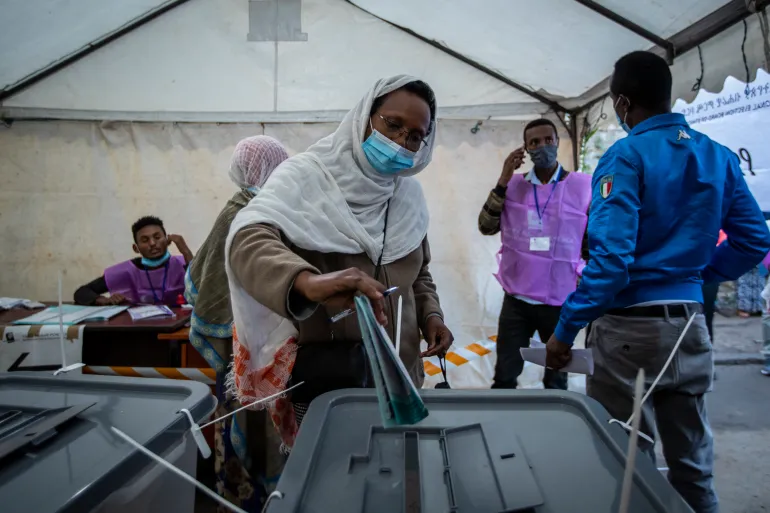
WASHINGTON DC, USA — On June 1, in the morning of 2026, Ethiopians joined queues at polling stations. On the same day, armed men descended on the villages in the Sharka district of the Arsi Zone, Oromia. At least 37 Orthodox Christian civilians lay dead, a century-old St. Gabriel Church had been reduced to ash, and more than 280 homes had been torched. The attack, beginning on the eve of the election and continuing through polling day, was not an aberration. It was a window into the reality that Ethiopia’s government had been trying to paper over with the performance of democratic participation.
Prime Minister Abiy Ahmed’s ruling Prosperity Party is poised to sweep Ethiopia’s seventh general election in a predictable landslide. The party, which already holds 457 of 547 parliamentary seats, ran uncontested in dozens of constituencies and faces an opposition so fragmented and weakened that analysts have called this one of the least competitive elections in the country’s modern history. The government will almost certainly frame the result as a popular mandate, a validation of its leadership, and proof of Ethiopia’s democratic maturity. None of those claims will be true.
This election does not mark a democratic milestone. It marks the consolidation of a system in which elections are held precisely because they cost little and legitimize much while the actual conditions for democracy, peace, and accountable governance remain absent.
A Hollow Electoral Landscape
To understand why this election cannot deliver peace or genuine representation, one must first reckon with the conditions under which it was held. Far from expanding political space, the Prosperity Party has spent the past five years steadily narrowing it.
The opposition entering this cycle is a shadow of what a competitive democracy requires. The power imbalances between the Prosperity Party and the opposition parties made the election structurally uncompetitive before a single ballot was cast. When voters face no real choice, an election does not express the popular will; it ratifies the absence of one.
Conflict as the Electoral Context
Ethiopia went to the polls while still bleeding from multiple armed conflicts. The Tigray region, home to roughly six million people and still recovering from a devastating two-year civil war that ended in a fragile 2022 peace agreement, was excluded entirely from voting. All 38 Tigrayan constituencies were suspended, with the electoral board citing “unfavorable conditions” and giving no specific timeline for when those citizens might vote. In Amhara, where the Fano militia controls swathes of countryside and has warned voters that participation makes them “complicit,” at least 30 constituencies were canceled.
Hundreds more polling stations across Oromia and Amhara opened late or closed early due to security incidents. Conflict-monitoring organization ACLED recorded more than 9,400 people killed in violence across those two regions alone in 2024.
The contradiction is stark and undeniable: a government cannot credibly claim a democratic mandate from an election in which millions of its citizens, those living in the most conflict-affected, government-contested areas—are physically unable to vote. When entire regions are excluded, when armed groups block transport routes, and when voters threaten not to go to the polls, the resulting tally does not reflect the nation. It reflects only the areas the government controls well enough to conduct a poll.
The Arsi massacre on election day crystallized this contradiction in blood. Dozens of civilians were killed while their government was conducting what it called a celebration of democracy. Whether the attack was carried out by the Oromo Liberation Army, as the Ethiopian Human Rights Commission’s preliminary findings suggest—or by other actors- it reveals the fundamental governance failure underlying the election’s façade. The current government repeatedly failed to protect ordinary citizens across vast stretches of its own territory while simultaneously claiming the authority that comes from their votes.
The Legitimacy Trap
Governments that hold elections amid conflict, fear, and unequal political competition use them as a legitimacy trap. They use the form of democracy to claim its substance while keeping the substance out of reach.
The Prosperity Party won about 94 percent of parliamentary seats in 2021. It will likely match or exceed that share in 2026. The government will cite those figures as proof of popular endorsement. International observers, including the African Union Election Observation Mission, led by former Kenyan President Uhuru Kenyatta, have already said the election “met most of its obligations.” Such assessments, however, carefully worded, offer diplomatic cover for a process whose structural flaws run far deeper than the procedural shortcomings that observer missions typically document.
There were allegations of serious irregularities in multiple constituencies, including claims that ruling party officials, public servants, and security personnel intimidated opposition observers and interfered directly in the electoral process. These allegations, whatever their ultimate evidentiary weight, reflect a recurring pattern across Ethiopian elections: formal compliance with procedural requirements coexists with systematic political pressure that tilts the outcome before ballots are counted.
The danger of the legitimacy trap is that it operates in two directions at once. Domestically, it allows the government to marginalize critics as anti-democratic for refusing to accept electoral results. Internationally, it enables the normalization of repression under a democratic veneer, insulating the government from accountability precisely when accountability is most needed.
The Election Cannot Remedy Ethiopia’s Crave for Genuine Peace
Genuine, durable peace in Ethiopia cannot be balloted into existence, least of all through an election engineered to produce a predetermined result. What Ethiopia requires, the Prosperity Party’s electoral theater cannot deliver and may actively foreclose. It requires inclusive political dialogue; not a managed competition between a dominant ruling party and hollowed-out opponents, but a serious reckoning with the communities whose grievances have fueled years of bloodshed. Tigrayan political actors remain largely outside the active national franchise as their region recovers from a devastating war.
Amhara communities living under the shadow of the Fano insurgency and federal military operations cannot cast a ballot that reflects their political reality. Oromo constituencies, whose most credible leaders have been imprisoned, exiled, or driven into armed opposition, are offered a choice between the Prosperity Party and parties too weakened to challenge it. An election that silences these voices does not drain the reservoir of grievance that fuels Ethiopia’s conflicts. It seals it under pressure, ensuring that what cannot be expressed politically will eventually be expressed violently.
Sustainable peace in Ethiopia demands far more than electoral choreography—it requires the hard, unglamorous work of post-conflict reconstruction, political pluralism, and negotiated coexistence among a constellation of deeply aggrieved communities.
First and foremost, it requires an inclusive political settlement that reflects Ethiopia’s diverse political interests. Post-conflict societies do not stabilize through the dominance of a single ruling apparatus; they stabilize through power-sharing frameworks, transitional justice mechanisms, and confidence-building measures that give every significant stakeholder a credible stake in the political order.
When the final results of Ethiopia’s seventh general election are announced, Prime Minister Abiy Ahmed will almost certainly claim a historic mandate. The Prosperity Party will point to turnout figures, to the number of candidates, to international observers’ cautious endorsements, and declare that the Ethiopian people have spoken.
But the Ethiopian people of Arsi’s burned villages did not speak on June 1. The millions of Ethiopians, excluded from the process, did not speak. The journalists detained, disappeared, and stripped of their accreditation did not speak. The opposition candidates who ran in constituencies where campaigning meant risking arrest spoke under duress, not in freedom.
An election conducted while civilians are massacred on polling day, while entire regions are suspended from the franchise, while independent media is shuttered and its editors forcibly disappeared, is not a democratic exercise. It is the theater of democracy; a performance whose purpose is to confer legitimacy without surrendering power.
Ethiopia’s path to sustainable peace does not run through elections held under these conditions. It necessitates inclusive dialogue that brings all concerned political stakeholders, armed groups, and marginalized communities to the table. Additionally, accountability mechanisms for atrocity crimes should be in place. Authentic press freedom, civic space, and practical political reforms are essential to enable opposition parties to compete and ensure citizens can choose freely without fear. Until those conditions are met, Ethiopia’s elections will continue to do what this one has done: confirm the ruling party’s dominance, legitimize its continued repression, and leave the country’s deep wounds unaddressed.
Disclosure
The views and opinions expressed in this article are solely those of the author, Negalegne M. Mandefro, a former Ethiopian diplomat in Washington, D.C., a Foreign Affairs and international conflict analyst. They do not necessarily reflect the views, editorial position, or policies of AfricaTells, its editors, management, or affiliates.