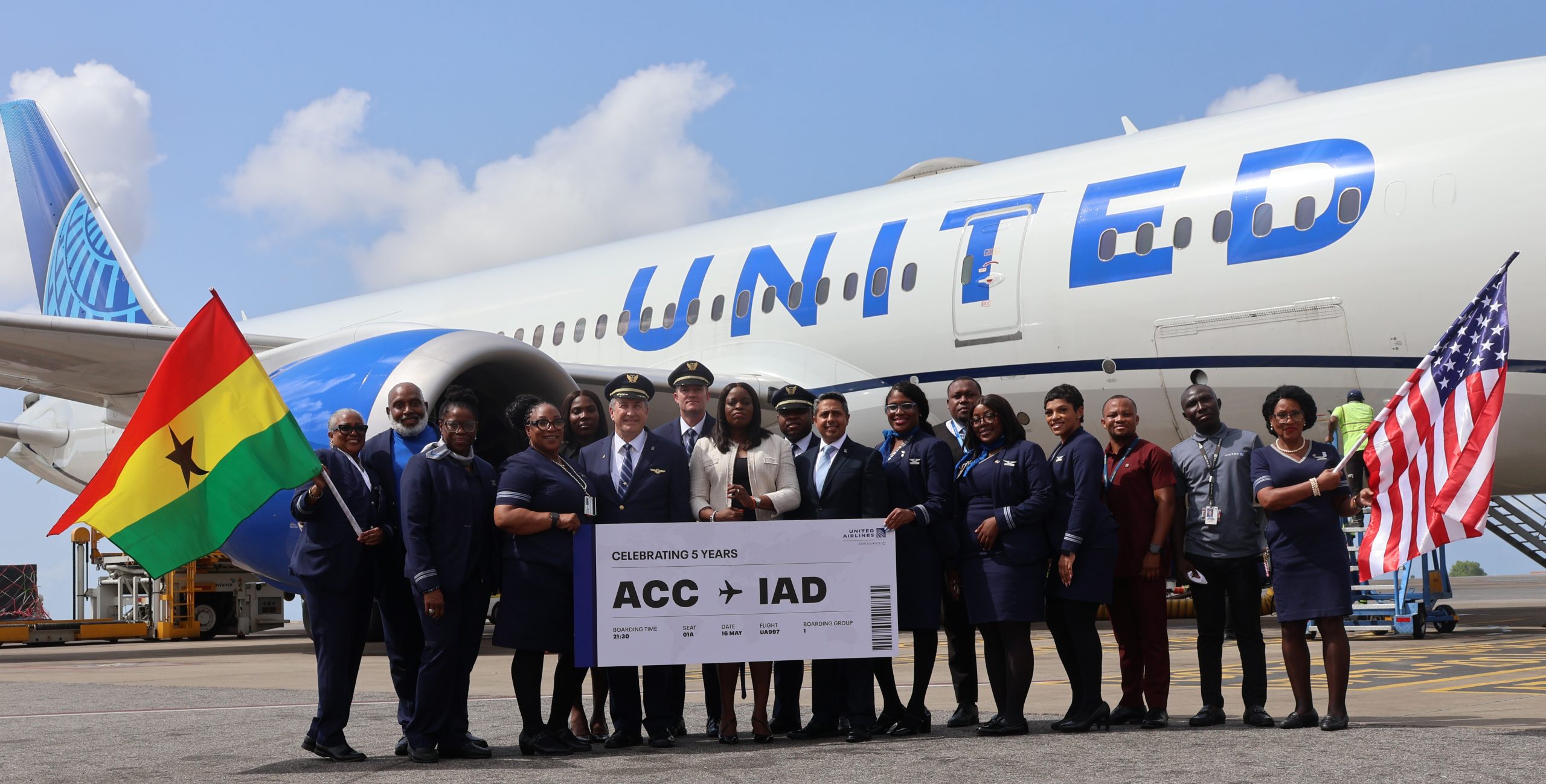
By the time United Airlines marked the fifth anniversary of its Accra–Washington service this month, the numbers had already begun telling a broader African aviation story.
Since the route launched in 2021, the carrier says it has operated more than 2,100 flights between Accra and Washington, D.C., transporting over 435,000 passengers and roughly 3,100 tonnes of cargo. Capacity on the route has expanded by 66% since launch, growing from three weekly frequencies to five during peak summer operations.
On paper, the announcement resembles a routine airline milestone. In practice, it reflects how African aviation is being reshaped by diaspora economics, geopolitical connectivity and competition over premium long-haul routes.
For years, transatlantic travel between West Africa and the United States depended heavily on European hubs such as London, Paris, Brussels and Amsterdam. Direct services were limited, fragmented and often commercially fragile. United’s sustained expansion in Ghana suggests the equation may be changing.
The route also arrives at a time when African governments are increasingly treating aviation as strategic infrastructure tied to trade, tourism, investment flows and regional influence.
Ghana’s diaspora strategy is feeding aviation growth
Ghana has steadily positioned itself as one of Africa’s most visible diaspora destinations, particularly following the “Year of Return” initiative launched in 2019. That policy push reshaped travel demand between the United States and West Africa, creating sustained traffic from diaspora communities, business travellers and cultural tourism.
United’s Accra route sits directly within that corridor.
The airline now deploys a Boeing 787-8 Dreamliner on the route, configured with 243 seats across business, premium economy and economy cabins. The aircraft choice itself is strategic. Long-haul African routes increasingly depend on fuel-efficient widebody fleets capable of balancing premium revenue with operational efficiency.
“We are proud to celebrate five years of connecting Accra with the U.S. capital and this anniversary underlines the importance of Ghana within United’s global network,” said Amit Badiani.
“As the only airline directly connecting Accra with Washington D.C., we are able to offer our customers greater travel choice with not only a direct connection to the U.S. capital, but also the possibility to connect onwards via our Washington/Dulles hub to over 65 additional destinations across the U.S.”
That onward connectivity is central to the route’s significance. Washington Dulles functions as one of United’s largest international gateways, with up to 285 daily flights serving more than 125 destinations. For West African travellers, direct access into a major U.S. hub reduces dependence on European transit airports while improving access to secondary American cities.
A wider battle for African aviation gateways
The Accra route also reflects a broader competition underway across African aviation.
International carriers are increasingly concentrating resources on a small number of African gateways considered commercially resilient and politically stable. Cities such as Accra, Lagos, Nairobi, Johannesburg and Addis Ababa are emerging as strategic entry points into continental markets.
For Ghana, United’s expansion carries symbolic weight beyond passenger figures. The airline remains the only carrier operating nonstop flights between Accra and Washington, giving it a competitive advantage in a market where time savings increasingly shape traveller preference.
The growth trajectory is also notable. A 66% increase in seat capacity within five years, suggests that demand on the route has moved beyond post-pandemic recovery into longer-term structural growth.
That trend matters because African long-haul routes were historically viewed by many global airlines as volatile or marginal. Several carriers reduced African exposure over the past decade due to currency risks, infrastructure constraints and fluctuating yields.
Yet the economics are changing.
The route’s cargo performance, more than 3,100 tonnes transported since 2021, highlights the increasing role of air freight in sustaining Africa-U.S. aviation links. Pharmaceuticals, perishables, e-commerce shipments and business cargo now contribute significantly to route viability.
Ethiopia, Gulf hubs and the new competitive pressure
United’s strategy in Ghana also intersects with a larger contest over who controls African connectivity.
Ethiopian Airlines continues to dominate intra-African and intercontinental aviation through its Addis Ababa hub model, while Gulf carriers such as Emirates and Qatar Airways have long relied on Middle Eastern transit networks to capture African passengers travelling to North America, Europe and Asia.
United’s Accra route reflects a different calculation: bypassing intermediary hubs entirely and integrating African cities directly into American airline systems.
That shift could alter the competitive balance.
For African airlines, the challenge is not merely competition from foreign carriers, but the possibility that premium passengers, business travellers, diplomats and diaspora customers, increasingly choose direct foreign-operated services over African hub connections.
At the same time, passengers benefit from reduced travel times and more efficient routing.
The broader policy issue remains unresolved: whether African states can accelerate continental aviation integration quickly enough to compete with expanding foreign carrier networks.
The African Union’s Single African Air Transport Market initiative was intended to liberalise African skies and strengthen regional connectivity. Progress, however, has remained slow due to regulatory fragmentation and protectionist aviation policies across the continent.
Aviation is becoming geopolitical infrastructure again
The United-Ghana route ultimately reflects more than commercial aviation demand.
Air connectivity increasingly mirrors geopolitical and economic alignments. Washington’s expanding engagement with West Africa, across trade, diplomacy and security cooperation, creates parallel incentives for stronger transport integration.
Airlines follow markets, but they also reinforce strategic relationships.
By deepening long-haul connectivity into Ghana, United is helping consolidate Accra’s role as a growing diplomatic and commercial node in West Africa. The route simultaneously strengthens Ghana’s position within broader U.S.-Africa mobility networks at a time when global carriers are recalibrating their African strategies.
Five years ago, nonstop flights between Accra and Washington looked like an ambitious post-pandemic experiment. Today, the route appears increasingly emblematic of a larger transformation in African aviation, one driven by diaspora capital, geopolitical competition and the race to control the continent’s most strategic air corridors.