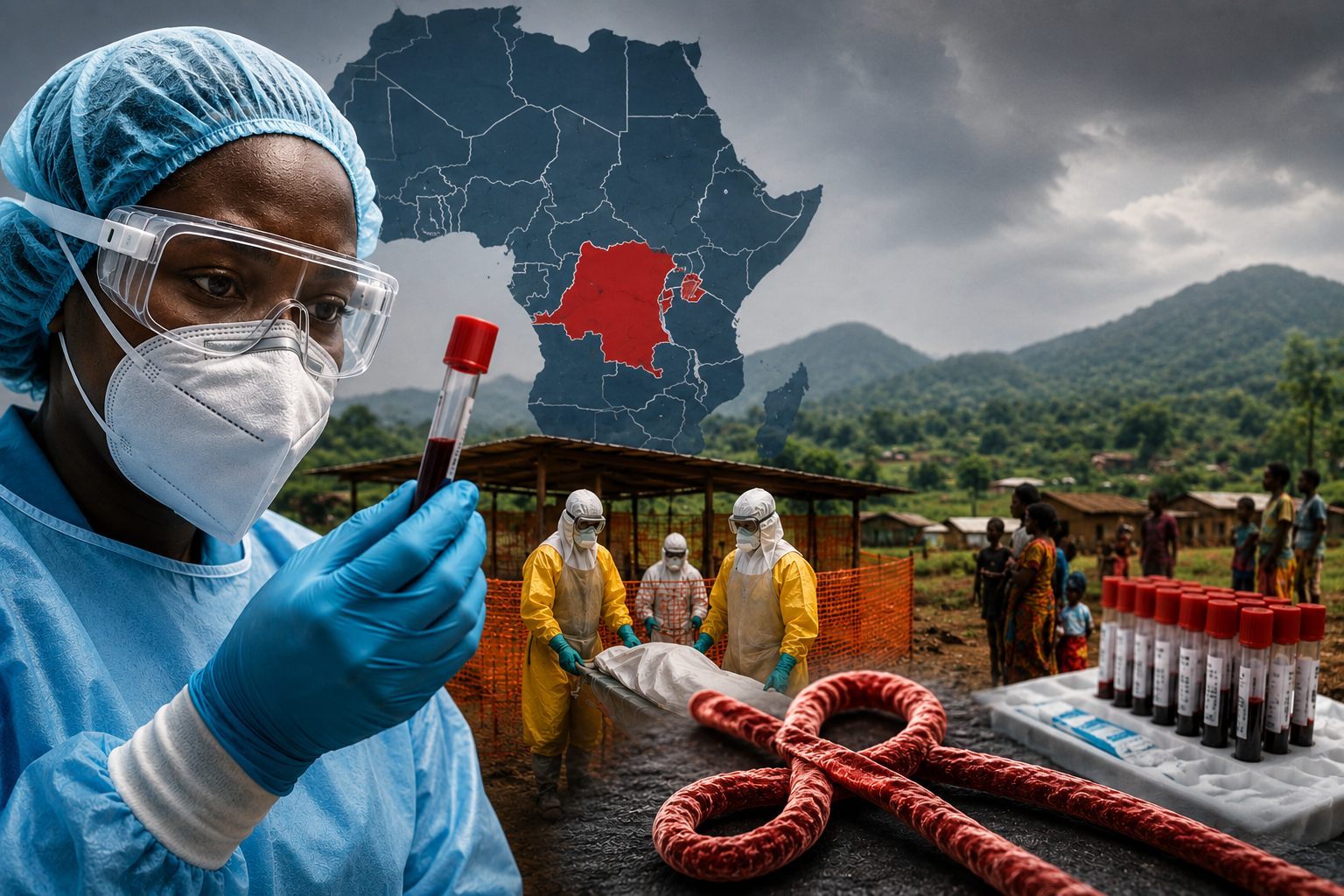
The United States is rapidly escalating its response to a new Ebola outbreak spreading across parts of Central and East Africa, deploying emergency funding, activating interagency crisis mechanisms and imposing travel restrictions within days of confirmed cases emerging in the region.
For Washington, the outbreak is already being treated not simply as a humanitarian emergency, but as a national security issue with direct implications for global mobility, health systems and geopolitical stability in Africa’s Great Lakes region.
“The first goal has been to ensure the safety of Americans abroad and the protection of the American homeland,” the US Department of State says in a statement released on May 18.
The outbreak, centred in the Democratic Republic of the Congo and Uganda, has triggered a coordinated American response involving the State Department, the Centers for Disease Control and Prevention (CDC), the Department of Homeland Security and US diplomatic missions across East and Central Africa.
Within 24 hours of confirmed cases being identified on May 15, Washington established an interagency coordination cell and incident management system in Washington DC. US embassies in Congo, Uganda, Rwanda and South Sudan simultaneously activated monitoring mechanisms to track developments and communicate with American citizens in the region.
The speed of the response reflects lessons learned from previous Ebola outbreaks that exposed how quickly fragile regional health crises can evolve into international emergencies.
Travel restrictions and outbreak containment
The Biden administration has now moved to tighten border controls and international screening procedures as concerns grow over cross-border transmission in one of Africa’s most mobile regional corridors.
Working with the CDC, Washington issued a Title 42 order on May 18 prohibiting entry into the United States for foreign nationals who have visited Congo, Uganda or South Sudan within the previous 21 days.
The State Department says it is also coordinating with the Department of Homeland Security on implementing future quarantine and isolation guidance globally.
At the same time, the CDC confirmed that one American citizen working in Congo has tested positive for Ebola after developing symptoms over the weekend.
“This is a highly complex situation,” says Satish Pillai during a CDC briefing. “CDC and our federal government partners have been working around the clock to ensure information is confirmed and accurate and that action plans are developed and executed with urgency.”
The infected American and several high-risk contacts are being transferred to Germany for treatment and monitoring, reflecting longstanding international reliance on specialised European isolation facilities during Ebola crises.
“Germany’s previous experience for caring for Ebola patients coupled with the flight times being significantly shorter” influenced the decision, Pillai says.
The CDC has also begun outreach to NGOs and aid organizations operating in Congo and Uganda, warning them about infection control risks and circulating updated guidance on viral hemorrhagic fevers.
Africa’s recurring outbreak vulnerability
The outbreak once again exposes structural vulnerabilities in African public health systems despite years of post-Covid investment and repeated Ebola containment campaigns.
Eastern Congo in particular remains one of the world’s most difficult epidemic environments. Armed conflict, population displacement, porous borders and weak infrastructure have repeatedly complicated disease surveillance and contact tracing operations.
Washington has now mobilised an initial $13m in emergency assistance aimed at strengthening laboratory capacity, surveillance systems, clinical management, safe burials and border screening operations.
The State Department says additional bilateral funding is expected as officials assess the scale of the outbreak.
Part of the response builds on existing bilateral health agreements signed with Congo and Uganda under the America First Global Health Strategy, which focused heavily on disease surveillance and outbreak preparedness.
The US is also leaning heavily on multilateral humanitarian infrastructure.
Washington says it is coordinating closely with the United Nations Office for the Coordination of Humanitarian Affairs (OCHA), while a previously announced $1.8bn contribution to OCHA pooled funds includes $250m earmarked for Congo and Uganda.
American officials are simultaneously leading donor coordination discussions with the European Union, the United Kingdom and other international partners in regional capitals.
The diplomatic language reveals growing awareness in Washington that epidemic management in Africa is increasingly tied to geopolitical credibility and strategic influence.
“American leadership remains indispensable in confronting global health threats,” the State Department says.
That framing reflects how global health security has become deeply securitized since Covid-19. Outbreaks are now viewed through the combined lenses of migration, border management, economic disruption and strategic competition.
For African governments, however, the outbreak revives longstanding concerns about dependency on external financing and emergency response systems whenever major epidemics emerge.
Both Congo and Uganda possess far stronger Ebola response experience than they did a decade ago. Uganda has repeatedly managed outbreak containment operations with relative speed, while Congo has accumulated extensive field expertise through multiple Ebola waves.
Yet the current crisis again demonstrates that large-scale outbreak response architecture in Africa still depends heavily on external logistics, donor financing and international emergency coordination mechanisms.
As regional health authorities race to contain transmission chains, the coming weeks will likely determine whether the outbreak remains geographically contained or evolves into another major transnational health emergency in Africa’s Great Lakes region.