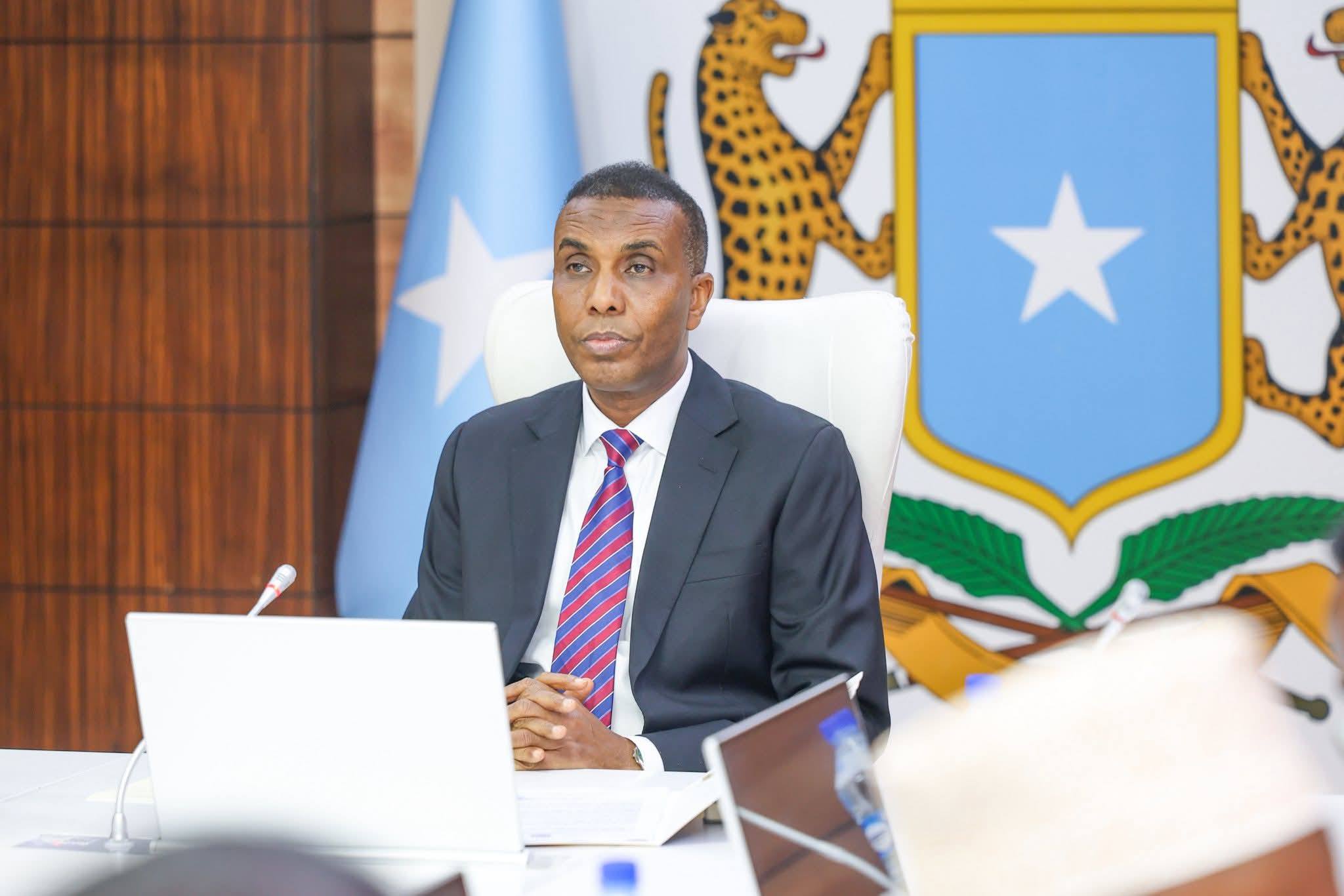
MOGADISHU SOMALIA — The government of Somalia is accelerating efforts to implement its long-delayed constitution, signaling a broader attempt to strengthen federal institutions and stabilize the country’s political transition amid rising tensions with opposition groups.
At a cabinet meeting in Mogadishu on Sunday, the Council of Ministers discussed a multi-year plan to operationalize the constitution between 2026 and 2029 — a process the government describes as central to national unity, governance reform, and institutional consolidation.
The meeting comes only days after talks between President Hassan Sheikh Mohamud’s administration and opposition figures ended without consensus, prompting concern from the African Union Commission over Somalia’s widening political divisions.
Prime Minister Hamza Abdi Barre told ministers that while the constitution has formally entered into force following presidential approval and publication, implementing it would require a lengthy and technically complex process, particularly on issues tied to governance and administration.
Building the architecture of the state
According to the Ministry of Justice and Constitutional Affairs, the roadmap aims to ensure that all constitutional provisions are progressively implemented over the next four years. Officials said the government will prioritize institutions considered critical to state functionality and national administration.
Among the bodies expected to be established or strengthened are the Judicial Service Council and the National Revenue Agency — institutions viewed as essential for centralizing governance authority and improving public administration in Somalia’s fragile federal system.
The ministry also indicated that detailed implementation plans for the next 12 months would be presented to the cabinet, taking into account security conditions and political realities across the country.
Why the process matters
Somalia’s constitutional process has remained incomplete for more than a decade, leaving unresolved disputes over federalism, power-sharing, elections, and the relationship between Mogadishu and regional states.
The renewed push to finalize implementation reflects the government’s attempt to move beyond provisional arrangements and institutional uncertainty. But it also risks intensifying friction with opposition groups that argue constitutional reforms require broader political consensus.
The timing is particularly significant as Somalia navigates a sensitive security transition, including the role of the African Union Support and Stabilization Mission in Somalia and ongoing operations against Al-Shabaab.
Cabinet broadens reform agenda
Beyond constitutional issues, the cabinet reviewed reports on recent elections in South West districts and discussions led by the president on electoral matters.
Ministers also approved a series of agreements and policy measures aimed at strengthening state institutions and international partnerships, including:
- a national sports development policy,
- reforms to Somalia’s social insurance system,
- an investment protection agreement with Saudi Arabia,
- renewal of an education cooperation agreement with Turkey,
- and new regulations governing district administrations in the Banadir region.
The cabinet additionally approved the promotion of Mohamed Rabiic Yusuf to the rank of ambassador as part of Somalia’s diplomatic representation to the United Nations.
Taken together, the decisions suggest the Somali government is attempting to project institutional momentum at a time when political consensus remains fragile and the country’s state-building process remains unfinished.