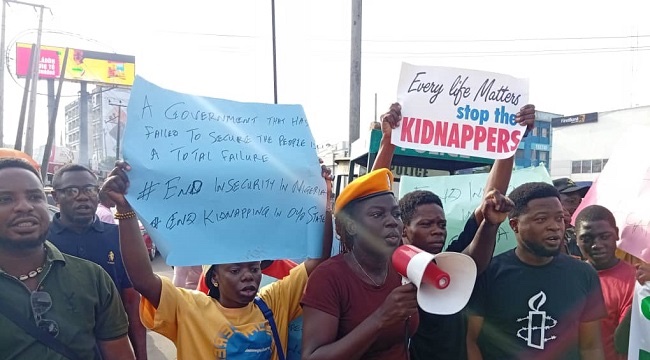
Teachers and pupils abducted in Oyo State have now been held in captivity for over two weeks, and on Tuesday, June 2, the Nigerian Union of Teachers turned that fact into a political reckoning, staging coordinated peaceful protests across the country, from Akure in Ondo State to Akwa Ibom in the south-south, from Kogi in the north-central to state capitals across the federation. The protests were not spontaneous grief. They were organised, simultaneous, and pointed, a profession declaring that the Nigerian state has ceased to protect the spaces where it claims to invest in the future.
The Oyo abduction did not occur in isolation. It emerged from a landscape of accelerating insecurity that has steadily consumed Nigeria’s rural and peri-urban zones, where schools sit exposed at the intersection of poverty, weak policing, and ungoverned terrain. The abduction of pupils and teachers, not soldiers, not politicians, not business figures, signals a shift in the targeting logic of armed groups operating across Nigeria’s south-west and middle belt. Where kidnapping for ransom once concentrated in the north-west and north-central regions, it has migrated south with disturbing momentum. Oyo Governor Seyi Makinde, facing the most politically damaging crisis of his tenure, urged Nigerians on Tuesday to stop apportioning blame and instead support government efforts to secure the victims’ release.
The appeal, however well-intentioned, landed in a public sphere that has exhausted its patience for process over outcomes.
The institutional response has been fragmented. State governments have issued statements. Federal security agencies have provided little visible operational clarity. And into this vacuum, civil society and religious leadership have stepped with increasing force. Enoch Adeboye, General Overseer of the Redeemed Christian Church of God, one of the largest Christian congregations on the African continent and a figure whose public statements carry genuine political weight across Nigeria’s south, issued a stark ultimatum to the federal government: give security chiefs ninety days to clear terrorists, or they should resign. The demand arrived not as pulpit rhetoric but as a calculated public intervention, framed against a backdrop of nationwide protests and growing alarm over the abduction of pupils, students, and teachers in Oyo State. That a figure of Adeboye’s stature chose this moment to break from customary deference to the presidency signals the depth of elite disillusionment with the security establishment.
The structural problem is neither new nor simple.
Nigeria’s security architecture has long suffered from coordination failures between federal agencies, state police equivalents, and local intelligence networks. But what Tuesday’s protests reveal is something more dangerous than institutional dysfunction, they reveal a crisis of civic trust.
The Nigeria Union of Teachers is not a radical organisation. It is a professional body representing people who show up to classrooms every morning, often without adequate pay, in buildings without adequate infrastructure. When such a body organises nationwide marches, the grievance has passed the threshold of routine complaint.
The Kogi State wing of the NUT described the kidnappings explicitly as an embarrassment and a threat to the education sector, language that, from a teachers’ union, carries the weight of institutional despair.
The timing is analytically significant. Nigeria in June 2026 is not merely managing a security emergency, it is managing that emergency while navigating a complex economic adjustment, a contested political horizon, and a deteriorating regional security environment. On the economic front, the Tinubu administration is attempting to demonstrate reform dividends. The Ministry of Finance Incorporated Real Estate Investment Fund has delivered N128 billion in affordable mortgage financing to 1,859 Nigerian families across 25 states, unlocking N221 billion in total property value and supporting 475 housing units nationwide, figures the president publicly lauded on Tuesday. The World Bank has simultaneously launched a two-week training programme to strengthen the post-clearance audit capacity of the Nigeria Customs Service. These are genuine, if incremental, governance achievements. But they are structurally incapable of absorbing the political fallout from schoolchildren held in captivity. Reform dividends that cannot be felt at the level of physical safety do not translate into legitimacy.
The political horizon compounds the pressure. Senior Advocate of Nigeria Dr. Charles Mekwunye raised pointed concerns on Tuesday about the increasing politicisation of the Independent National Electoral Commission, warning that the credibility of the 2027 general elections may already be under threat. His framing — that credible elections are impossible under the present INEC structure — is not merely a legal opinion. It is a barometer of elite sentiment about institutional decay. When security chiefs are being publicly challenged to resign within ninety days and the electoral commission’s independence is being questioned by senior lawyers, the Tinubu administration faces not a single crisis but a compound one: the simultaneous erosion of its security legitimacy, its institutional credibility, and its reform narrative.
Against this domestic turbulence, Nigeria’s diplomatic activity continued at pace. Romuald Wadagni, President of the Republic of Benin, visited Abuja on Monday for talks with President Tinubu covering trade, bilateral security, and ECOWAS affairs. The visit is notable not only for its substance but for its context: Wadagni on Tuesday also travelled to Niamey in what sources describe as the first visit by a Beninese head of state to Niger since the 2023 coup fractured relations between the two neighbours. Niger’s military rulers had closed the border with Benin after accusing it of harbouring French military bases intent on destabilising the junta. That Wadagni is now engaging both Abuja and Niamey within the same diplomatic window suggests Benin is positioning itself as a quiet bridge between ECOWAS’s reform agenda and the Sahel’s coup belt — a role that carries both opportunity and exposure.
The ECOWAS dimension matters for Nigeria specifically because Abuja remains the bloc’s anchor. With Mali, Burkina Faso, and Niger having withdrawn from ECOWAS to form the Alliance of Sahel States, the organisation’s credibility as a security and governance framework depends in large part on Nigeria’s own institutional coherence. A Nigeria visibly struggling to protect its schools and respond to kidnappings is a Nigeria with diminished moral authority to hold the regional line on democratic norms. Ambassador Jimoh Ibrahim’s election on Tuesday as Chairman of the Fifth Committee of the United Nations General Assembly, the body responsible for the UN’s administrative and budgetary affairs — is a genuine diplomatic achievement and a mark of Nigeria’s continued institutional standing internationally. But international prestige and domestic security capacity are not fungible. One does not substitute for the other in the eyes of a parent whose child has been missing for two weeks.
Watch whether the Tinubu administration responds to Adeboye’s ninety-day ultimatum with concrete, named security deliverables or retreats into vague reassurance, the choice will signal whether the presidency is reading the room or managing it. Watch whether the Oyo abduction victims are released before the NUT escalates from protest to strike action, which would transform a security crisis into an education system shutdown. Watch whether Benin’s diplomatic outreach to Niger produces any softening of the border closure or any re-engagement with ECOWAS frameworks, which would test the bloc’s capacity to recover relevance in the Sahel. And watch whether the 2027 electoral anxiety now being voiced by senior lawyers and civil society leaders coalesces into organised institutional reform demands, because in Nigeria’s political economy, the security crisis and the electoral crisis are not separate files.
SOURCES
- Vanguard News. Insecurity: Ondo NUT stages rally over abduction of Oyo teachers, pupils. Tue, 02 Jun 2026
- Channels Television. Give Security Chiefs 90 Days To Clear Terrorists, Or They Resign, Adeboye Tells FG. Tue, 02 Jun 2026
- AllAfrica / Premium Times. Nigeria: Akwa Ibom Teachers Join Nationwide Protest Over Oyo Abduction Incident, Shut Down Schools. Tue, 02 Jun 2026
- BusinessDay. NUT protests rising insecurity in schools. Tue, 02 Jun 2026
- BusinessDay. Kogi State NUT described kidnapping as an embarrassment, threat to education sector. Tue, 02 Jun 2026
- This Day Live. Makinde: Stop Apportioning Blame Over Teachers’, Students’ Abduction, Support Govt’s Efforts in Their Release. Tue, 02 Jun 2026
- This Day Live. President of Benin, Wadagni, Meets Tinubu in Abuja Over Trade, Security, ECOWAS. Tue, 02 Jun 2026
- Channels Television. Benin President In Niger, A First Since Coup Sparked Tensions. Tue, 02 Jun 2026
- Nairametrics. FG: MREIF delivers N128 billion in mortgages to 1,859 Nigerian families. Tue, 02 Jun 2026
- This Day Live. Tinubu Lauds MREIF For Delivering N128bn In Affordable Mortgages To 1,859 Nigerian Families. Tue, 02 Jun 2026
- Vanguard News. World Bank boosts customs audit capacity. Tue, 02 Jun 2026
- Vanguard News. 2027: Credible elections impossible under present INEC structure — Mekwunye, SAN. Tue, 02 Jun 2026
- This Day Live. Nigeria’s Jimoh Ibrahim Elected Chair of UN General Assembly’s Fifth Committee, Pledges Reform, Fiscal Discipline. Tue, 02 Jun 2026