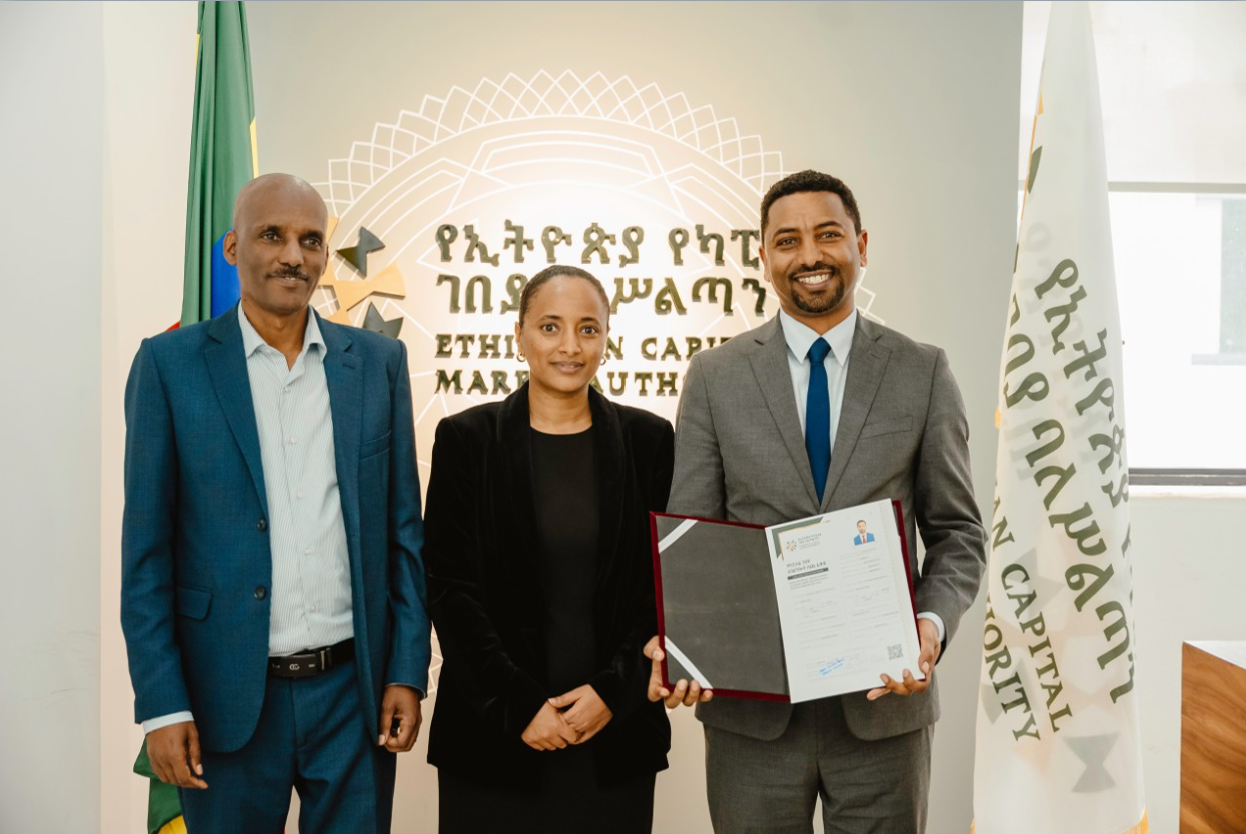
ADDIS ABABA – When Michael Addisu set out to build First Studies Investment Bank, he made a choice that most people in his industry would consider unusual. He stayed independent. No commercial bank affiliation, no group ownership, no institutional parent. In a financial sector where most advisory players are tethered to larger banking conglomerates, that independence is, he argues, precisely the point.
“It makes us a neutral player,” says Michael, founder and CEO of what he describes as Ethiopia’s first independent investment bank. “Combining strong local context with international experience, we plan to provide value-adding, innovative, and need-based investment advisory and in the future, brokerage and trading services.”
The timing is deliberate. Ethiopia’s capital markets are at an inflection point. The Ethiopian Securities Exchange is operational. The Ethiopian Capital Markets Authority is functioning. The regulatory architecture, by most assessments, is not just ready. It is ahead of the market it was built to serve.
Infrastructure Ahead of Its Time
That gap between framework and function is one of the defining features of Ethiopia’s capital markets moment. Michael is candid about it.
“The preparation in terms of regulatory framework, technological and physical infrastructure is well ahead of where the market actually is,” he says. “There has been significant attention and commitment to setting up, operationalising, and building the capacity of ECMA and ESX. But having the exchange is only one part of a successful capital markets ecosystem.”
The other parts, the transaction advisors, brokers, dealers, custodians and central securities depositories, are still catching up. Yet the pace is accelerating. The number of licensed capital market service providers has nearly doubled in four months, from around six or seven to close to thirteen.
“That is encouraging,” Michael says. “But at the end of the day, we need issuers who are looking for capital and investors who want to buy, sell, and buy again. That requires awareness, confidence, and an easy and affordable trading platform. When all of these come together, I am very optimistic we will have a vibrant capital market in a short period of time.”
The Patient Capital Problem
One of the structural tensions in Ethiopia’s emerging market is the mismatch between the type of capital the economy needs and the investment behaviour of its largest institutional players.
Pension funds, insurance companies and sovereign wealth entities, the natural anchors of any deep capital market, have historically gravitated toward short-term instruments, fixed deposits and property. The reasons are understandable: high country risk premiums, limited product options and the fiduciary obligations of managing long-term liabilities.
“In developing economies like Ethiopia, we need more patient capital, capital that can stay without high velocity, without speculation or short-term arbitrage, in order to finance long-term developmental projects,” Michael explains.
The demand for long-term funding, whether for greenfield private sector investment, growing share companies or major infrastructure, is substantial. The supply of patient capital willing to meet it is not.
Recent reforms are beginning to shift the equation. The opening of the government securities market, including treasury bills, to retail and direct investment gives institutional players a new entry point into safe, predictable instruments. Ethiopian Airlines issuing securities to finance the new airport terminal at Bishoftu is an early signal of what sovereign-linked issuance could look like at scale.
But Michael is direct about what institutional players must now confront. “I don’t think we will be able to manage our insurance companies the way we managed them in the last twenty years. We have to sit down, rethink, and revise our strategies in terms of investment, competitiveness, and optimum utilisation of funds.”
The Foreign Exchange Hurdle
For international investors watching Ethiopia’s capital markets from a distance, the foreign exchange environment remains the single largest deterrent. Michael identifies two distinct concerns: the exchange rate itself and the ability to exit.
Ethiopia’s recent forex reforms, moving toward a more market-determined exchange rate and relaxing restrictions on foreign currency holdings, have improved the optics. But Michael is measured in his assessment of their impact.
“This is good to boost confidence for foreign investors in particular,” he says. “But the ability to liquidate your investment and exit out of the country, we still have some way to go in building that confidence.”
The result is a market in a holding pattern. “Everybody is in sit-and-wait mode when it comes to the Ethiopian capital market,” Michael says. “They understand the exchange rate risk. The repatriation risk is still perceived to be high. We need further reform on that, and we need to communicate it as widely as possible.”
Reaching the Rural Investor
Perhaps the most complex challenge in Ethiopia’s capital markets story is also its most politically significant: inclusion. The government has explicitly stated a goal of widening participation beyond Addis Ababa’s urban professional class. But translating that ambition into reality requires confronting hard questions about what rural Ethiopians actually need from financial markets.
Michael approaches the question with the precision of someone who has thought carefully about the difference between aspiration and evidence. The banking sector controls 96 percent of Ethiopia’s financial sector and within that, roughly 95 percent of depositors hold balances of less than 200,000 birr. The depositor base is broad. The question is whether those depositors are ready to become investors.
“Are you on the demand side or the supply side?” he asks. “To what extent do rural farmers have disposable income they are planning to invest in a primary or secondary market? It requires a thorough socioeconomic analysis.”
His concern is one of misallocation: building expensive infrastructure for a segment of the population whose most pressing financial needs may be savings products, micro-insurance or safety net services rather than equity trading. Inclusion, in his framing, does not mean universal participation. It means making participation possible for those who are ready and willing.
For that, he has a clear answer: technology.
“I don’t think there will be a physical outlet to reach segments of society living in urban and peri-urban areas,” he says. “Technology is the most affordable and accessible way of reaching those communities.”
What Comes Next
First Studies Investment Bank is, for now, an advisory firm. Brokerage and trading services are on the roadmap. But Michael’s immediate priority is simpler: help issuers and investors understand each other, and help the market develop the confidence it needs to move.
Ethiopia’s capital markets have the architecture. They have the regulator. They have, increasingly, the service providers. What they need, awareness, trust, patient capital and a credible path to foreign participation, is harder to build than any exchange platform.
Michael believes it is buildable. And he believes an independent, internationally minded investment bank, with two decades of institutional memory in Ethiopia’s development finance landscape, is well placed to help build it.
“I am very optimistic,” he says. “In a short period of time, we will have a very vibrant capital market.”
The infrastructure is ready. The ecosystem is forming. The question now is whether the market and the capital behind it are ready to meet it.