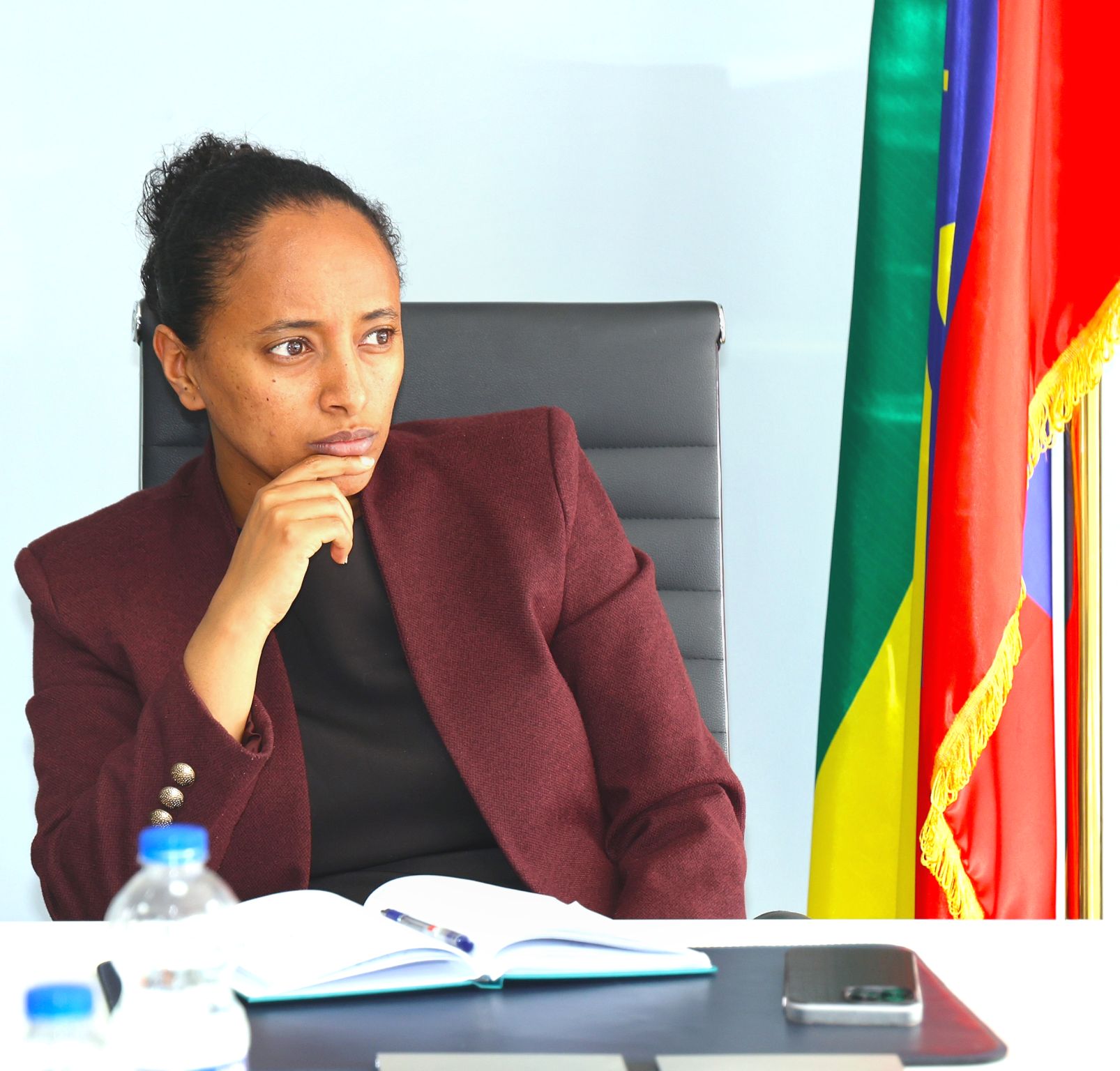
ADDIS ABABA, ETHIOPIA – As Director General of the Ethiopian Capital Market Authority (ECMA), Hana is overseeing the legal and institutional architecture behind Ethiopia’s transition toward a modern securities market, a reform agenda tied directly to Prime Minister Abiy Ahmed’s broader economic liberalisation programme. The stakes are high. Ethiopia is attempting to create an equity and debt market before fully resolving structural shortages in foreign exchange, inflationary pressure, weak corporate disclosure culture, and low public trust in formal investment systems.
The result is that Tehelku’s role extends far beyond technical regulation. She has become part educator, part state reformer, part market evangelist, and part financial police officer, trying simultaneously to persuade Ethiopians to trust capital markets while warning companies that transparency is no longer optional.
From financial crimes prosecutor to market regulator
Before entering financial regulation, Hana spent a decade as a prosecutor handling corruption, tax, and financial crime cases, experience that now heavily shapes her regulatory instincts.
Unlike many capital market regulators who emerge from investment banking or economics, she came into the market through enforcement. That background matters in Ethiopia, where informal finance, opaque ownership structures, and weak disclosure standards have historically dominated parts of the private sector.
Her transition into ECMA reportedly followed a highly competitive recruitment and vetting process. She initially joined as head of legal affairs before being elevated to Director General only months later.
The promotion came with what she has publicly described as “imposter syndrome”, an unusually candid admission in Ethiopia’s bureaucratic culture, where vulnerability is rarely discussed openly by senior officials.
Building a market before a market culture exists
One of Hana’s core arguments is that Ethiopia’s challenge is not simply launching a stock exchange. It is creating an investment culture almost from scratch.
She frequently rejects the idea that capital markets are “for the rich”, arguing instead that functioning markets require broad participation from retail investors, pension funds, insurance firms, cooperatives, and family businesses.
That philosophy reflects a larger policy problem Ethiopia faces: financial inclusion remains shallow despite rapid economic growth over the past two decades.
Tehelku’s public messaging increasingly resembles civic education as much as financial regulation. In interviews and public forums, she repeatedly stresses that entering the market must be an intentional business decision rather than a fashionable policy trend.
Ethiopia’s capital market is also a political reform project
The creation of ECMA and the Ethiopian Securities Exchange (ESX) forms part of Ethiopia’s wider post-2018 economic reform agenda, which seeks to gradually open sectors previously dominated by the state.
The capital market project is therefore not merely financial infrastructure. It is a signal to investors, lenders, and multilaterals that Ethiopia is attempting to modernise its economic governance systems.
Hana operates inside that politically sensitive transition.
The balancing act is delicate. The government wants investment, liquidity, and privatisation momentum. But regulators must also avoid market manipulation, elite capture, and politically connected speculation in a country with limited experience in securities oversight.
That contradiction increasingly defines ECMA’s institutional role.
Her regulator’s philosophy: approval is not endorsement
One of the most repeated warnings from ECMA under Hana’s leadership is that regulatory approval does not mean investment safety.
The distinction became particularly visible after Dashen Bank’s prospectus approval process, where the Authority stressed publicly that approval merely confirms compliance with minimum disclosure standards and should not be interpreted as investment advice.
That position reflects global securities regulation norms, but in Ethiopia it represents a major cultural shift.
For decades, many Ethiopians associated state approval with implicit guarantees. Capital markets require the opposite logic: risk disclosure, investor responsibility, and informed speculation.
Hana’s ECMA is therefore trying to institutionalise a completely different financial psychology.
The disclosure revolution
Perhaps the least understood aspect of Ethiopia’s capital market reforms is the cultural collision around disclosure requirements.
According to Hana, ECMA often returns between 30 and 35 pages of comments on a single prospectus draft. Companies are pushed to disclose liabilities, operational risks, governance structures, and financial vulnerabilities many Ethiopian businesses historically kept private.
In practical terms, this may become one of the biggest governance shifts in modern Ethiopian corporate history.
Many family-owned firms grew under informal systems where financial opacity was treated as a survival mechanism. Public listing demands the opposite: visibility.
The friction between those two cultures is already emerging quietly across boardrooms.
Touring Ethiopia to sell capitalism
Rather than concentrating outreach only in Addis Ababa’s financial circles, Hana and ECMA officials have travelled extensively across regional cities including Jijiga, Mekelle, Bahir Dar, Jimma, and Arba Minch.
The symbolism matters.
One of the recurring criticisms of Ethiopia’s economic reforms is that they disproportionately benefit urban elites, politically connected investors, or Addis-based institutions. ECMA appears aware of that perception risk.
Hana has repeatedly argued that Ethiopia’s capital market cannot survive as an “Addis project”.
The outreach campaign also reflects a practical reality: many regional businesses, cooperatives, and diaspora-linked enterprises could eventually become future issuers or investors.
She is pushing fintech into a conservative financial system
Hana’s ECMA is not only focused on conventional securities trading. The Authority is also preparing the legal ground for digital sub-brokers, app-based trading systems, robo-advisory platforms, and AI-supported financial services.
That signals Ethiopia’s attempt to leapfrog parts of traditional market infrastructure.
The irony is striking. Ethiopia remained one of Africa’s most financially closed economies for years. Yet parts of its regulatory architecture are now being designed with advanced digital finance models already in mind.
Still, implementation risks remain significant. Digital literacy gaps, cybersecurity vulnerabilities, and weak investor protection systems, could become major stress points if adoption accelerates faster than regulation.
Islamic finance may become a turning point
One of ECMA’s most politically and economically important initiatives under Tehelku has been the exploration of Islamic capital market products.
The Authority has studied Sharia-compliant instruments, including Sukuk structures, to attract participation from Ethiopia’s large Muslim population, many of whom have historically avoided interest-based financial products.
This is not merely a religious accommodation. It is a liquidity strategy.
If successfully implemented, Islamic capital market products could significantly widen domestic investor participation while also attracting Gulf-linked financial interest.
The move aligns Ethiopia more closely with financial trends already visible in countries such as Malaysia, Saudi Arabia, and Nigeria.
Forex reform changed the conversation
Hana’s optimism about Ethiopia’s capital market is closely linked to broader macroeconomic reforms, particularly foreign exchange liberalisation.
Recent forex reforms signaled to international investors that dividend repatriation may gradually become easier, one of the biggest concerns long raised by foreign investors operating in Ethiopia.
At the same time, the expansion of the interbank money market is helping establish market-based pricing benchmarks necessary for future corporate bond markets.
Since October 2024, the interbank market has reportedly traded more than 1.5 trillion birr.
Without those parallel reforms, Ethiopia’s capital market ambitions would likely remain largely theoretical.
The woman wearing “the white dress and the black suit”
Hana often describes her job using an unusual metaphor: simultaneously wearing a traditional white dress and a black suit.
The image captures the duality of her position.
On one side, she must promote the market, encourage participation, attract issuers, and build optimism around a new financial future. On the other, she must discipline misconduct, investigate fraud, and enforce rules against the very actors she is trying to attract.
That tension sits at the heart of modern market regulation everywhere. But in Ethiopia, where institutions are still being built while reforms are unfolding in real time, the contradiction is especially acute.
Hana’s leadership style reflects what she calls “servant leadership”, the idea that leaders ultimately serve causes rather than personalities.
Whether Ethiopia’s capital market succeeds will depend on far more than one regulator. Inflation, political instability, foreign exchange shortages, and institutional trust will all shape the outcome.
But for now, Hana has become one of the faces of a broader national gamble: that Ethiopia can build sophisticated financial institutions before its economic transition fully stabilises.