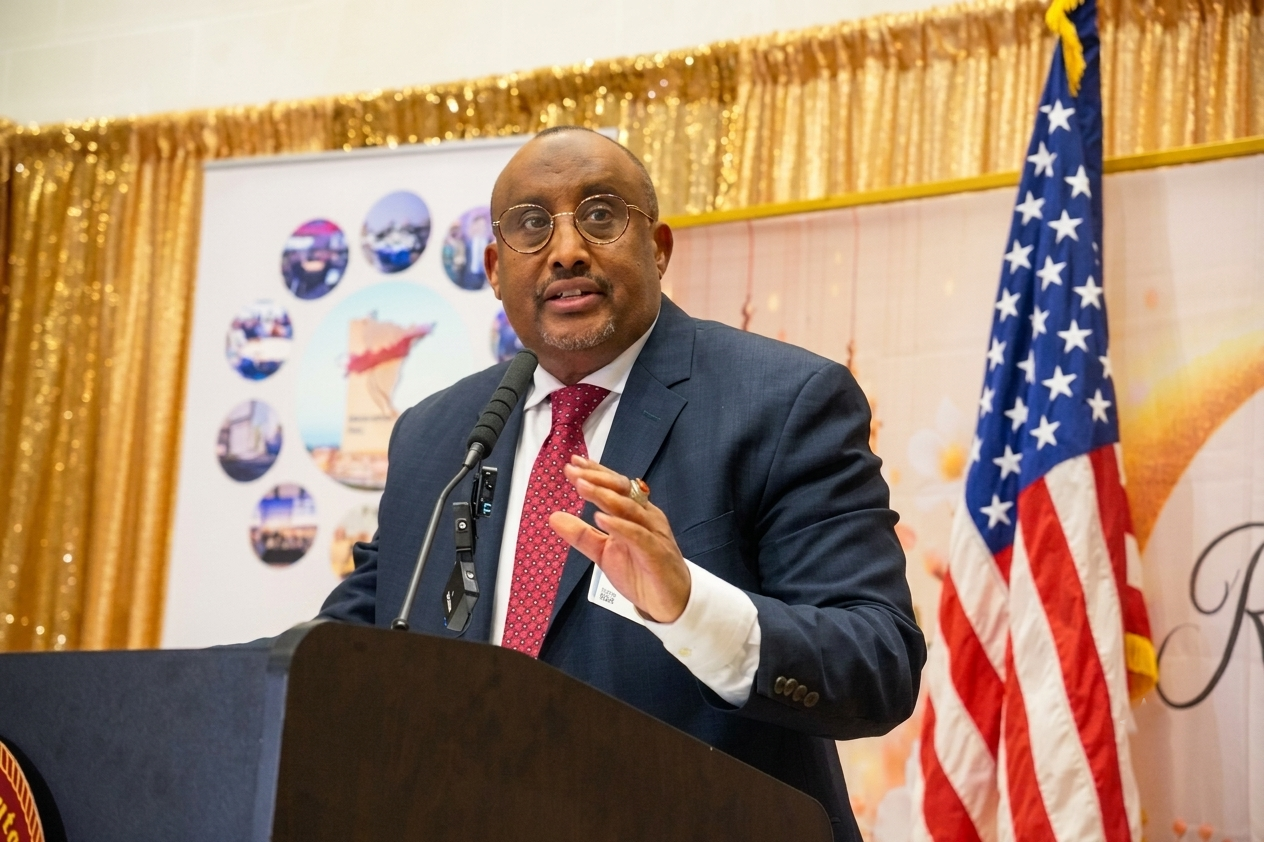
MINNESOTA, USA – In a wide-ranging political interview, Dr. Abdiweli Mohamed Ali Gaas, an economist, former Prime Minister of Somalia, and former President of Puntland, offers a rare and detailed account of Somalia’s post-collapse state-building journey. Drawing on decades of academic training, public service, and direct political experience, he argues that Somalia’s future depends not on individual leaders, but on the strength and independence of its institutions. His reflections touch on education, public finance, federalism, security, constitutional reform, and the enduring cost of institutional collapse.
This is an Op-Ed written by Eng. Mohamed Ismail, Founder and Executive Director of the Minnesota Institute of Horn of Africa Studies. It reads as an analytical commentary on a political interview with Dr. Abdiweli Mohamed Ali Gaas, conducted on the Geed-Fadhi platform.
A Reflection on Somali State-Building
Dr. Abdiweli Mohamed Ali “Gaas” speaks in this interview as an economist, scholar, former Prime Minister of Somalia, and former President of Puntland. His reflections go beyond his personal political record. They address Somalia’s wider struggle with leadership, institutions, federalism, security, education, public finance, and economic development.
From the perspective of the Minnesota Institute of Horn of Africa Studies, this interview can be understood as an important political and historical reflection on Somali state-building. Dr. Gaas presents his experiences through the lens of institutional leadership, constitutional order, public sector reform, and national responsibility.
Dr. Abdiweli Mohamed Ali, widely known as Dr. Abdiweli Ali Gaas, is a Somali-American economist, academic, and senior statesman. He served as Prime Minister of Somalia from 2011 to 2012 and later as President of Puntland from 2014 to 2019. He played an important role in Somalia’s transition process and in the formation of permanent federal institutions.
Dr. Gaas has a strong educational background. He earned a Bachelor’s degree in Economics from Somali National University, a Master’s degree in Economics from Vanderbilt University, a Ph.D. in Economics from George Mason University, and a Master’s degree in Public Administration from Harvard Kennedy School. He also studied taxation at Harvard Law School. His academic training and experience as a university professor shaped his focus on governance, federalism, public finance, economic development, and institutional reform.
About the Geed-Fadhi Interview Platform
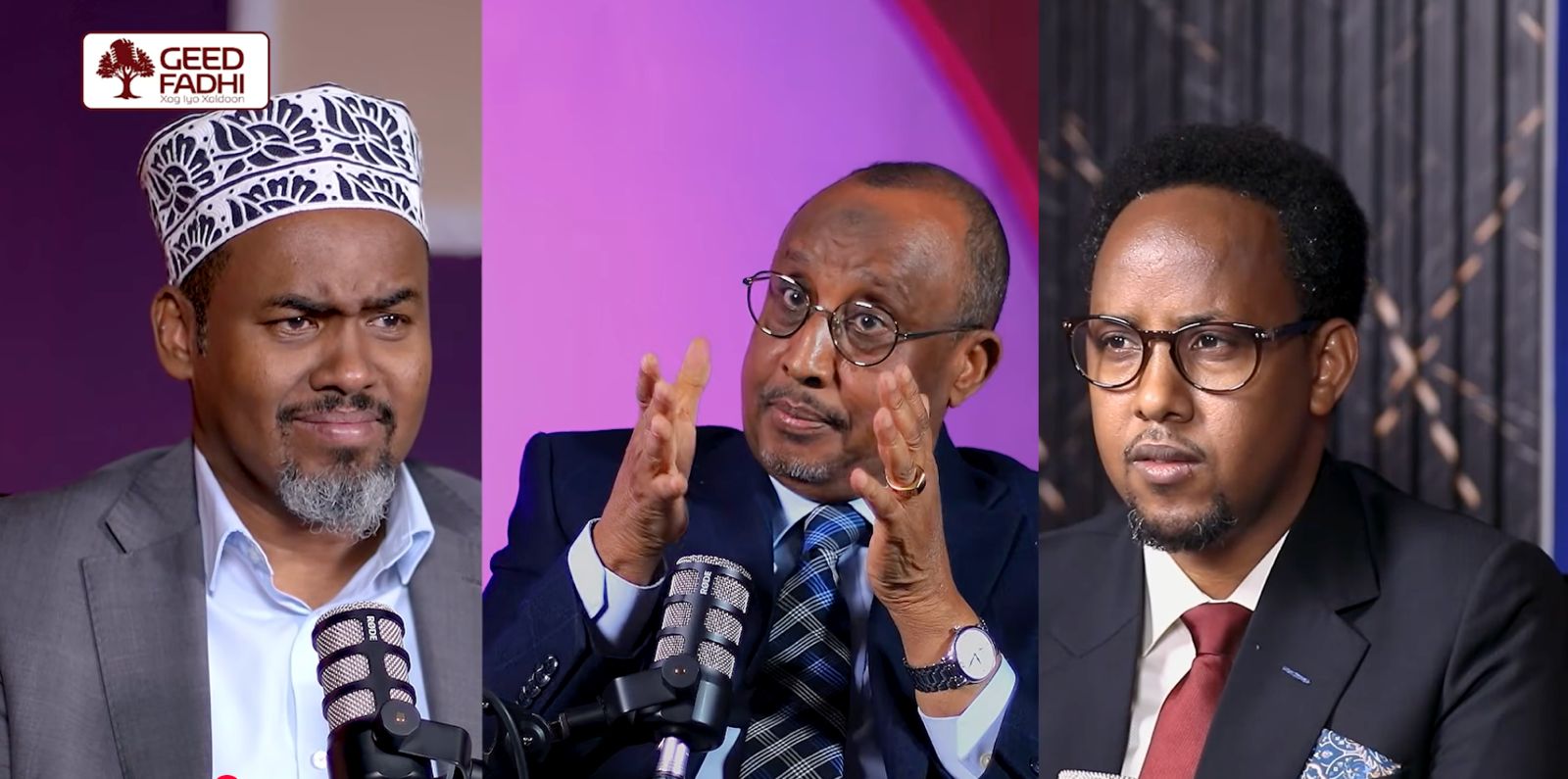
The interview was conducted on Geed-Fadhi, a Somali political discussion platform associated with Somali Stream and KAARtalk. The program was hosted by Abdinur Mohamed Ahmed and Abdikarim Ali Kaar.
Abdinur Mohamed Ahmed is a Somali media personality and former Director of Communications in the Office of the President. Abdikarim Ali Kaar has also served as a spokesperson for Villa Somalia. Both are Somali political journalists and commentators who have contributed to the current rise of serious Somali political interviews.
The name “Geed-Fadhi” reflects the traditional Somali practice of gathering under a tree to discuss public affairs, politics, leadership, and community issues. In this sense, the platform connects modern political dialogue with a deeply rooted Somali tradition of consultation, public discussion, and collective reflection.
The Analyst’s Meeting with Dr. Gaas
The analyst met Dr. Abdiweli Mohamed Ali Gaas at a 2025 event organized by the Minnesota Institute of Horn of Africa Studies. During the event, Dr. Gaas delivered a thoughtful speech that was warmly received by participants, including government officials, academics, Minnesota senators, state legislators, mayors, and community leaders. His remarks reflected long experience in governance, public finance, and institutional reform.
Minnesota State Representative Samakab Hussein described Dr. Gaas as a friendly, humble, and honorable leader whose character and conduct earned the respect of those in attendance. This personal encounter gave the analyst a deeper appreciation of Dr. Gaas’s humility, intellectual depth, and statesmanship.
Dr. Asad Ali-weyd, author of Rebuilding Somalia: A Journey of Resilience, Reform, and Renewal and Founder and President of the New American Development Center in Minnesota, also presents Dr. Gaas as an important Somali leader and thinker who contributed his book.
“Dr. Abdiweli Mohamed Ali Gaas is an important Somali leader and thinker whose reflections add political and intellectual value to Rebuilding Somalia: A Journey of Resilience, Reform, and Renewal. His belief that Somalia’s future depends on strong, professional, and independent institutions reflects his direct experience as former Prime Minister of Somalia and former President of Puntland. He is also recognized for his humility, friendliness, and support for emerging educators.”
Education, Public Finance, and Leadership Formation
Dr. Abdiweli Mohamed Ali Gaas began his career in education and public service after graduating from the University of Somalia, where he served as an assistant lecturer. He later worked under Abdullahi Warsame Noor, whom he described as a man of honor. Through this experience, Dr. Gaas gained important lessons in taxation, public finance, import substitution strategy, administrative discipline, and professional responsibility.
He explained that Somalia once had a functioning public finance system that used practical incentives to reduce corruption. For example, tax collectors were officially given up to 20 percent as an incentive, which reduced the need for bribery and encouraged proper revenue collection.
Dr. Gaas also recalled the rapid economic decline Somalia experienced during that period. When he traveled to the United States for his scholarship, one U.S. dollar was equal to about 16 Somali shillings. However, when he returned within two years, the rate had reached around 400 Somali shillings. This sharp inflation affected salaries, food prices, ordinary bills, and daily life.
After only eight months of work, Dr. Gaas received an opportunity to attend a public finance course provided by the IMF in 1989. In August of the same year, he was admitted to the Ph.D. program at George Mason University. This was one of his academic ambitions because of the university’s strong reputation in economics and its connection to Nobel Prize-winning economists James Buchanan and Vernon Smith.
Dr. Gaas later built a distinguished academic career, teaching and working with many African and international leaders, including former Ethiopian Prime Minister Hailemariam Desalegn. His academic journey included institutions such as Pennsylvania State University, the University of Nizwa in Oman, and Niagara University, where he became a professor. When he later returned to Somali politics, he brought strong economic knowledge, international experience, public finance expertise, and a deep understanding of governance.
Education and National Development
Dr. Gaas reflects deeply on the role of education in state-building. He compares his experience at Somali National University with education systems abroad, showing how Somalia once had strong public institutions that invested seriously in human capital.
At Somali National University, especially at the Gahayr campus, students received free tuition, free accommodation, free textbooks, free health services, meals, and pocket money of 240 Somali shillings, along with guaranteed employment after graduation. Dr. Gaas praised the high quality of education, the academic environment, and the infrastructure at Gahayr.
He explained that the education he received in Somalia prepared him well for international academic competition. After winning the AFGRAD Scholarship, becoming one of only five selected from 62 competitors, he was able to join Vanderbilt University directly. He took the TOEFL and GRE, met the required academic standards, and joined classes within one month without needing any preparatory program.
This experience, in his view, demonstrated the strength of Somalia’s education system at that time. It also shows that the collapse of Somali institutions was not only a political crisis; it damaged education, weakened professional capacity, and disrupted the development of future generations.
President Aden Adde as a Leadership Model
One of the most important themes in the interview is Dr. Gaas’s respect for Somalia’s first president, Aden Abdulle Osman, widely known as Aden Adde. Dr. Gaas presents Aden Adde as a model of justice, fairness, discipline, and institutional leadership.
Dr. Gaas recalls that Gen. Abdullahi Farah Walaf once told him that Aden Adde was not only a good president for Somalia, but a leader whose qualities were strong enough to serve as president of a highly developed Western democracy, even the United States. Dr. Gaas also refers to a February 2013 conversation with former Prime Minister Abdirizak Haji Hussein, where Aden Adde was used as an example of a leader who placed institutions above clan loyalty and personal interest.
In that conversation, the example was the military succession after the passing of General Da’ud Abdulle Hirsi, the Chief of the Somali National Army. According to Dr. Gaas’s account, Aden Adde respected the institutional rule that the deputy should assume the position, regardless of clan considerations during a sensitive time of military and police leadership balance. President Aden Adde encouraged the Prime Minister to follow the regulation and move forward. This decision helped Mohamed Siad Barre rise within the military structure.
Dr. Gaas uses this example to show that Aden Adde respected institutional procedure even when political and clan pressure could have influenced the decision. For Dr. Gaas, Aden Adde represents the type of leader Somalia needs: a leader who puts the state before the clan, the constitution before personal ambition, and public institutions before private interest.
Rebuilding Institutions from Weakness
Dr. Gaas repeatedly emphasizes that Somalia’s greatest challenge is the weakness of state institutions. In his view, no country can achieve stability, development, or good governance without institutions that are competent, respected, and protected from political abuse.
To support this argument, he refers to international examples. Italy, despite frequent changes of government since World War II, has remained stable because its institutions continued to function. Singapore, under the leadership of Lee Kuan Yew, demonstrated how visionary leadership can build disciplined and effective institutions that continue beyond one leader. Dr. Gaas also mentions the founding fathers of the United States, who created a constitutional system based on checks and balances, federalism, rule of law, and protection of public institutions.
At the Ministry of Planning, Dr. Gaas says he started almost from scratch and worked to rebuild the institution. He invited Abdullahi Sheikh, who had served as Director of the Technical Department during Somalia’s central government, to strengthen the ministry’s technical capacity.
He explains that during the central government period, the Director of the Technical Department could act as the counterpart of the United Nations representative. This showed that Somali institutions once had professional structure and administrative authority. After the collapse of the state, however, international representatives often sought meetings directly with presidents, prime ministers, or ministers instead of engaging technical departments and professional civil servants. For Dr. Gaas, this shows how deeply Somalia’s administrative institutions had weakened.
This part of the interview reflects one of Dr. Gaas’s central arguments: leadership alone is not enough. Somalia needs ministries, departments, civil servants, laws, procedures, and systems that can function beyond individual leaders.
Becoming Prime Minister During a Political Crisis
Dr. Gaas explained that his appointment as Prime Minister of Somalia came at a highly sensitive moment in the country’s transitional politics. At the time, Somalia’s Transitional Federal Government was facing a serious political crisis involving Speaker of Parliament Sharif Hassan Sheikh Aden, President Sheikh Sharif Sheikh Ahmed, and Prime Minister Mohamed Abdullahi Farmajo.
The crisis eventually led to the Kampala Accord, an agreement reached between the President and the Speaker of Parliament. One of the central outcomes of that agreement was the resignation of Prime Minister Farmajo. According to Dr. Gaas, when he and Abdinur Sheikh Mohamed, the Minister of Education, learned of the decision, they were deeply concerned and both decided to resign in protest.
Dr. Gaas and Abdinur then called Prime Minister Farmajo and informed him of their decision. Farmajo immediately traveled to Kampala and requested to meet with the President. Later, President Sheikh Sharif called Dr. Gaas and Abdinur to a meeting with him and Prime Minister Farmajo. During that meeting, the President explained that an agreement had been reached for Farmajo to resign and for Dr. Gaas to assume the position of Prime Minister. Dr. Gaas said he asked Farmajo directly whether this was true, and Farmajo confirmed it.
Dr. Gaas also requested that Abdinur be fully included in the discussion because both of them had made their decision together. In that difficult and uncertain moment, President Sheikh Sharif, Prime Minister Farmajo, Dr. Gaas, and Abdinur made a solemn commitment regarding the political arrangement.
However, the matter became more complicated after Farmajo returned to Mogadishu. The political atmosphere changed, and Farmajo reconsidered his position. Despite the tension and confrontation that followed, Dr. Gaas ultimately assumed the office of Prime Minister.
This experience shows that Dr. Gaas’s appointment did not come through an ordinary political transition. It came during a period of crisis, disagreement, public pressure, and political confrontation within the Transitional Federal Government.
The Constitution and the End of the Transition
Dr. Gaas presents the completion of Somalia’s Interim Federal Constitution as one of the major achievements of his tenure as Prime Minister. Somalia had spent many years struggling to move beyond the transitional period, and his government played a central role in advancing the constitutional process.
Under his leadership, an expert committee was formed and led by Professor Mohamed Osman Jawari. According to Dr. Gaas, the constitutional process was completed within seven months after years of delay and uncertainty. He also praised Abdirahman Hosh Jibril, the Minister of Constitutional Affairs, for his dedication and commitment to the success of the process. Dr. Gaas noted that both Professor Jawari and Abdirahman Hosh Jibril have since passed away, and he asked Allah to grant them mercy.
The adoption of the Interim Federal Constitution on August 1, 2012, marked a major turning point in Somalia’s political history. It provided the legal foundation for the federal system and helped move the country away from the transitional framework toward more permanent federal institutions.
Dr. Gaas also discussed the challenges surrounding the swearing-in of members of parliament. The plan was to swear in the members on August 20, 2012, but obstacles emerged, including the closure of the intended venue at School Polizia. Due to security and logistical difficulties, the ceremony was carried out at the airport runway. This example reflects the difficult environment in which the government was operating and the determination of the leadership to complete the transition.
Reforming Parliament and Political Morality
Another major issue Dr. Gaas discussed was the attempt to reform parliament. He said he tried to prevent warlords and individuals he believed lacked moral integrity from entering the new parliament. In his view, Somalia needed a more credible and responsible political class.
However, he also admitted that some of those individuals entered parliament without his consent and in front of his own eyes. This reflects the limits of reform during Somalia’s transitional period. Even when leaders had reformist intentions, they faced powerful networks of clan pressure, political bargaining, armed influence, and external interests.
This part of the interview is important because Dr. Gaas does not present reform as easy. He acknowledges the difficulty of changing a political system shaped by conflict, mistrust, and competition for power.
Security and the Difficulty of Governing
Dr. Gaas explains that governing from Mogadishu during his time as Prime Minister was extremely difficult because of insecurity. Government offices, ministries, and even the presidential palace were regularly targeted by al-Shabaab. This created a dangerous environment for government officials and civil servants.
He describes a state that was expected to perform national responsibilities while lacking resources, competent staff, security, and stable institutions. His reflection shows that Somalia’s leaders were operating under extraordinary pressure. They had to build institutions while those same institutions were under attack.
This security environment limited movement, weakened planning, reduced public service delivery, and made long-term reform difficult.
Federalism and the Politics of Power Sharing
Dr. Gaas also discusses federalism and the relationship between the federal government and regional states. He explains that cooperation between Puntland and the federal government was generally possible, even though disagreements existed over power sharing and constitutional authority.
He worked with President Hassan Sheikh Mohamud for three years and one month and described that period as one in which meaningful cooperation was possible. He also welcomed President Mohamed Abdullahi Farmajo to Puntland in January 2018, after Farmajo came to power. Farmajo’s visit from Galkayo to Bosaso was highly welcomed and was described as a historic event. In the same year, Prime Minister Hassan Ali Khaire was also welcomed in Puntland.
These examples show that Dr. Gaas viewed federal cooperation as necessary for Somalia’s stability and national progress. At the same time, he believed that regional states must have their constitutional role respected and should not be treated as weak administrative branches of the federal government. For Dr. Gaas, federalism was about balance, cooperation, and mutual respect between the center and the regions.
Puntland Leadership and Development Record
As President of Puntland, Dr. Gaas strongly defended his leadership and development record. He highlighted major projects in infrastructure, airports, ports, and public investment during his five-year tenure. According to Dr. Gaas, when he assumed office, Puntland was relatively isolated and lacked modern airport infrastructure. By the time he left office, the region had two paved airports in Garowe and Bosaso.
He also discussed the development of Bosaso Port. Dr. Gaas explained that business leaders came to him and described the challenges they were facing in trade and logistics. Their concerns pushed him to seek investment and modernization for the port. He supported the involvement of DP World in Bosaso Port as part of a broader strategy to strengthen Puntland’s role in trade, logistics, investment, and regional economic development.
At the same time, Dr. Gaas emphasized that development is the responsibility of leaders. In his view, building airports, improving ports, expanding public services, and investing in infrastructure are not favors to the people; they are duties that leaders must perform. Leaders do not need to praise themselves for doing what their position requires. However, when criticism becomes unfair or politically motivated, he believes it is reasonable to respond with facts and records.
Dr. Gaas also made clear that he is not the type of leader who uses social media activists to exaggerate his achievements or discredit others. Instead, he said his record should be judged through real projects, public evidence, officials who were involved, budgets, decisions, and living witnesses. He challenged Puntland leaders before and after him to explain what they had accomplished in comparison.
This part of the interview shows that Dr. Gaas is sensitive to political criticism, but he does not respond only through emotion. Instead, he answers criticism through records, names, budgets, projects, and witnesses. His style is calm, academic, and evidence-based.
Dr. Abdiweli Ali Gaas on the 2016 Garowe Electoral Proposal
Dr. Gaas explained that Puntland initiated a proposal in Garowe for a 51-member assembly to help shape Somalia’s electoral process. According to him, the proposal was intended to move Somalia toward a more representative, institutional, and constitutional electoral model.
He argued that the 4.5 clan power-sharing formula was not consistent with the Roadmap, Garowe I, and Garowe II agreements. In his view, many Somalis regarded the 4.5 system as unfair and not a genuine form of representation. At the same time, he acknowledged that the system had provided some advantage to communities that might otherwise have been underrepresented. For that reason, he believed Somalia needed a gradual transition away from direct clan-based power sharing toward a district-based model that could still protect political balance among Somali communities.
Dr. Gaas proposed that Somalia’s electoral model should be based on the country’s 92 districts. Under his proposal, each district would receive three representatives, producing 276 seats. An additional 31 seats would be reserved for balancing and inclusion, bringing the total number of seats to 307.
He defended the district-based model by explaining the historical formation of Somalia’s districts. Somalia had 48 districts in 1969, and during the 21 years of Siad Barre’s rule, 44 additional districts were created. Dr. Gaas argued that these districts were not randomly established to favor one clan, but were distributed across different regions and communities.
He explained that the Samaroon and Isse communities received districts such as Lughaya and Baki from those 10 districts. The Isaaq received districts such as Sheikh and Ainabo. The Warsangeli received Dhahar and Badhan. The Dhulbahante received Taleex and Xudun. The Majeerteen received Dangoroyo and Burtinle. He also noted that additional districts were created in areas where the Digil and Mirifle communities were present, including Tiyeglow, Wajid, Qansax Dheere, Saakow, Sablale, Dujuma, and Bu’aale (Partially Digil & Mirifle).
Dr. Gaas further explained that Mogadishu alone had 16 districts, which would give Banadir strong representation under a district-based electoral model. In his view, the number of seats some communities would receive under the district-based model could be comparable to what they received under the 4.5 formula, but with a stronger institutional and constitutional basis.
Overall, Dr. Gaas presented the 92-district proposal as a fairer and more legitimate alternative to the 4.5 system. He argued that it could preserve political balance while gradually moving Somalia from clan-based power sharing toward district-based representation and citizenship-based politics.
Leadership Style: Academic, Detailed, and Institutional
The interview shows Dr. Gaas as a calm and academic political figure. He speaks with the style of an economist and professor. He often explains events by naming the people involved, describing the scene, recalling the sequence of decisions, and connecting the event to a broader institutional lesson.
This style makes the interview valuable not only as a political defense, but also as a historical record. He does not simply say what happened; he explains why it mattered, who was involved, and what institutional lesson should be learned from it.
His focus is not only on defending himself. He is also presenting a larger argument: Somalia’s future depends on whether it can build institutions that are stronger than clan politics, personal ambition, and temporary political conflict.
The Politics of Institutional Leadership
Dr. Abdiweli Mohamed Ali Gaas’s interview is a major reflection on Somalia’s struggle to rebuild the state after collapse. His central message is that Somalia’s problem is not only the absence of good leaders, but the weakness of institutions. Without strong institutions, even good leaders cannot create lasting change. With strong institutions, countries can survive political change, leadership turnover, and internal disagreements.
His admiration for Aden Adde shows the type of leadership he values: justice, fairness, constitutional discipline, and respect for institutional procedure. His experience as Minister, Prime Minister, and President of Puntland shows the difficulty of applying those principles in a political environment shaped by insecurity, clan competition, limited resources, and weak administrative capacity.
The interview also shows Dr. Gaas defending his record. He speaks about constitutional reform, parliamentary reform, federalism, Puntland infrastructure, airports, port development, and cooperation with federal leaders. At the same time, he presents these issues within a larger framework of state-building.
For Somalia, the lesson from this interview is clear: political stability cannot be built only through personalities, clan agreements, or temporary settlements. It requires institutions, laws, professional civil servants, constitutional order, economic development, and leaders who respect the state more than personal power.
Dr. Gaas’s interview is therefore not only a discussion of his own career. It is a broader statement on what Somalia must become if it is to move from crisis management to real state-building.
Disclosure
The views, opinions, and analysis expressed in this article are solely those of the author, Eng. Mohamed Ismail, and do not reflect the editorial position, views, or policies of AfricaTells. AfricaTells assumes no responsibility for the content or claims made in this Op-Ed.