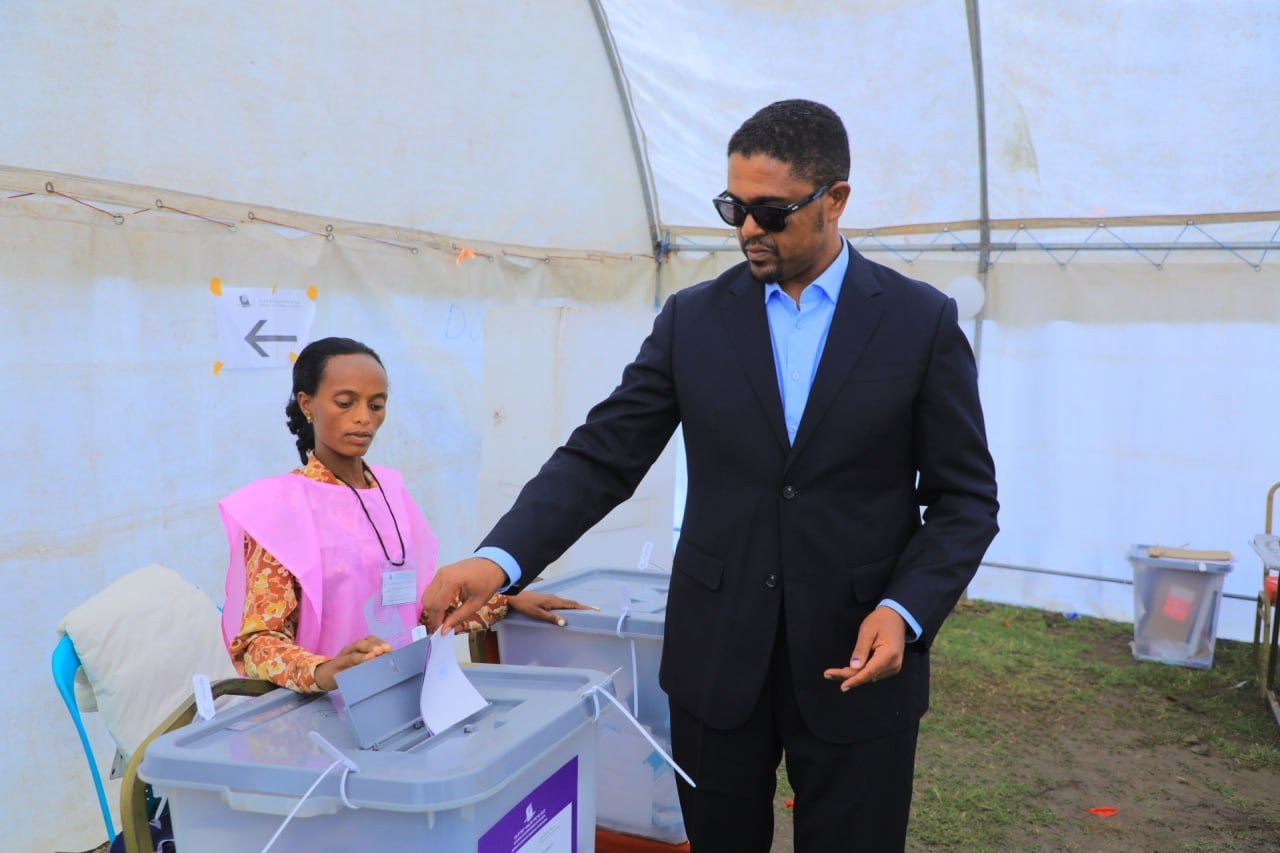
GINCHI, ETHIOPIA — Oromia Regional State President Shimelis Abdisa has described Ethiopia’s election as a milestone in the country’s long struggle to replace political force with democratic competition, praising voters for turning out in large numbers despite security challenges and political tensions.
Speaking after casting his ballot, Shimelis said Ethiopia’s democratic culture has been shaped through years of sacrifice and remains a work in progress.
“The process of building the Ethiopian nation has passed through many challenges,” he said. “The culture of democracy has lagged behind because everything was dictated by force and weapons, and responsibility rested with dictators instead of the people.”
According to the Oromia president, successive generations have paid a heavy price to establish a system in which political power is determined through elections rather than coercion.
“Power is obtained through the people’s ballot”
Shimelis said this year’s election took place amid efforts by groups seeking to disrupt the voting process, but argued that voters had rejected those attempts by participating in large numbers.
“In this election, forces that wanted to destroy Ethiopia worked to prevent people from registering and voting,” he said. “Despite all of this, our people registered. Today, they have come out in large numbers to cast their votes.”
He described the turnout as evidence of the public’s determination to strengthen democratic institutions and secure Ethiopia’s future.
“This clearly shows how much the people are willing to sacrifice for the construction of a democratic culture,” he said.
The regional president also directed a message to political parties and competitors, arguing that elections should settle political contests.
“We must understand our people’s commitment that power is obtained only through democratic means and the people’s ballot,” he said. “We must stop all forceful methods and enter this modern democratic system.”
Accepting the people’s verdict
Responding to questions about whether political actors would accept the election results, Shimelis said all parties should respect the outcome once voters have made their choice.
“The people have come out to decide. They are lining up and casting their votes even late into the night,” he said. “Every one of us is expected to accept this voting process.”
“On our part, we are ready to accept what our people have decided, and every force should do the same.”
Shimelis argued that the real test begins after the election, when those entrusted with power must deliver development and good governance.
“What matters is what happens after the people’s decision,” he said. “How will the party that receives the people’s mandate fulfill their needs for development and good governance? That is the great responsibility.”
“The Ethiopian people are the winners”
While political parties compete for office, Shimelis said the election’s ultimate beneficiaries should be Ethiopian citizens themselves.
“Above all, the Ethiopian people are the winners,” he said. “In this process, no one else but the Ethiopian people are the winners.”
He also praised election officials, observers, media organizations, and security personnel for their role in conducting the vote.
“Their sacrifice is a living monument to Ethiopia’s endurance,” he said.
Calling for stronger institutions and continued democratic reform, Shimelis said Ethiopia must learn from its mistakes while building on its successes.
“If we do this, our democratic culture can transition to a higher level,” he said.