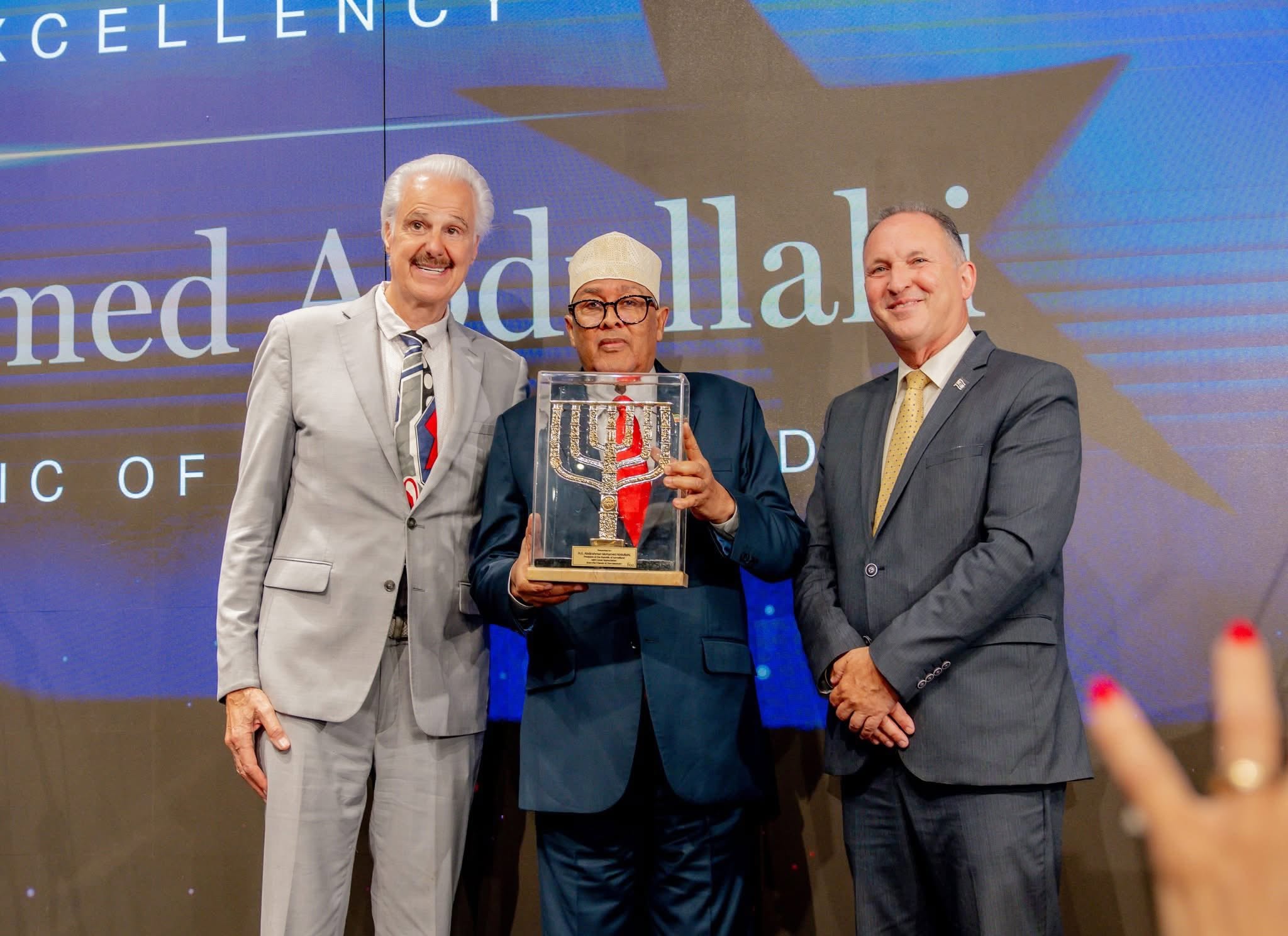
HARGEgISA, SOMALILAND – Somaliland President Abdirahman Mohamed Abdillahi Cirro stood alongside Israeli leaders in Jerusalem this week, receiving the Friends of Zion Award and holding meetings with Prime Minister Benjamin Netanyahu, President Isaac Herzog, Finance Minister Bezalel Smotrich, Economy Minister Nir Barkat, and senior members of the Knesset. The visit came months after Israel formally recognized Somaliland as an independent state on December 26, 2025, becoming the first major Middle Eastern country to do so.
For Somaliland, the symbolism was as significant as the diplomacy itself. After more than three decades of functioning as a de facto state without broad international recognition, the territory is seeking to convert stability, democratic governance, and strategic geography into diplomatic legitimacy. The Israel visit was not merely a state visit. It was an effort to demonstrate that Somaliland’s recognition campaign has entered a new phase, one focused on building strategic partnerships with states willing to challenge long established diplomatic assumptions about the Horn of Africa.
Jerusalem Becomes a New Front in Somaliland’s Recognition Campaign
Somaliland declared independence from Somalia in 1991 following the collapse of the Somali state and the end of the civil war against the regime of Mohamed Siad Barre. Since then, it has built many of the institutions associated with sovereign statehood, including elected governments, security forces, a central bank, and its own currency.
Yet international recognition has remained elusive. Most governments continue to support Somalia’s territorial integrity under the principle inherited from post-independence African borders. As a result, Somaliland has spent decades operating in diplomatic limbo. It has attracted foreign investment, hosted international partners, and maintained relative stability compared with much of the Horn of Africa, but without formal recognition from most countries.
Recent years have seen a gradual shift. The expansion of Berbera Port, investments linked to Gulf states, growing competition in the Red Sea corridor, and renewed interest in maritime security have elevated Somaliland’s strategic value. Its location along one of the world’s busiest shipping routes has made it increasingly difficult for major powers to ignore.
Israel’s recognition represented the most consequential diplomatic breakthrough in Somaliland’s history. Unlike symbolic parliamentary resolutions or unofficial contacts, formal recognition by a sovereign state creates a precedent that Somaliland hopes other governments may eventually follow. Cirro’s visit therefore served two purposes: consolidating the gains already achieved and demonstrating that recognition can translate into tangible economic, security, and political cooperation.
Recognition Meets Geopolitics in the Horn of Africa
The meetings in Jerusalem highlighted the breadth of cooperation now under discussion. Somaliland officials and Israeli counterparts explored investment opportunities, technological cooperation, infrastructure development, agriculture, water management, energy projects, and financial collaboration.
Particular attention focused on Berbera Port and the surrounding free trade zone, assets that have become central to Somaliland’s economic strategy. As global competition intensifies around Red Sea shipping lanes, ports, logistics corridors, and maritime infrastructure have become increasingly important geopolitical assets.
For Israel, Somaliland offers potential strategic value beyond economics. The territory sits near critical maritime routes linking Europe, the Middle East, and Asia. Security concerns in the Red Sea, including piracy, regional instability, and disruptions to global shipping, have increased interest in reliable partners along the corridor.
The relationship also reflects broader shifts in Middle Eastern diplomacy. Over the past decade, Israel has expanded ties with African states through cooperation in agriculture, technology, security, and trade. Somaliland’s search for international partners intersects with Israel’s desire to broaden its diplomatic footprint across Africa and secure partnerships along strategically important maritime routes.
Yet the relationship is unlikely to be free of controversy. Somalia has consistently opposed any international recognition of Somaliland and continues to regard the territory as part of its sovereign territory. Israel’s decision therefore introduces another layer of complexity into an already sensitive regional landscape. It could encourage Somaliland’s supporters while simultaneously provoking diplomatic resistance from Mogadishu and some of its partners.
A Diplomatic Victory That Still Faces Major Obstacles
The enthusiastic reception accorded to Cirro in Jerusalem reflects how far Somaliland has come from the isolation that characterized much of its early existence. The Friends of Zion Award, meetings with Israel’s highest political leadership, and the signing of a strategic cooperation framework all project the image of a territory increasingly acting as a sovereign state on the international stage.
However, recognition by one country does not fundamentally resolve Somaliland’s international status. The challenge remains convincing additional states to follow Israel’s lead. That task becomes particularly complicated in Africa, where governments have traditionally been cautious about supporting secessionist movements due to concerns about their own territorial integrity.
Somaliland’s leadership appears aware of this reality. Rather than presenting recognition as an end point, officials increasingly frame it as part of a broader strategy centered on governance, economic development, and strategic partnerships. The argument is that recognition should follow demonstrated state capacity rather than precede it.
The Israel relationship may strengthen that case if it produces measurable outcomes. Investments in infrastructure, technology transfer, agricultural modernization, and financial cooperation could provide evidence that international engagement delivers concrete benefits. Conversely, if the partnership remains largely symbolic, its diplomatic impact may be limited.
For Somaliland, the larger objective remains unchanged. The territory seeks not only bilateral relationships but also broader acceptance within regional and international institutions. Achieving that goal will require navigating complex regional politics, managing relations with neighboring states, and persuading skeptical governments that Somaliland’s case is unique rather than a precedent for wider border revision across Africa.