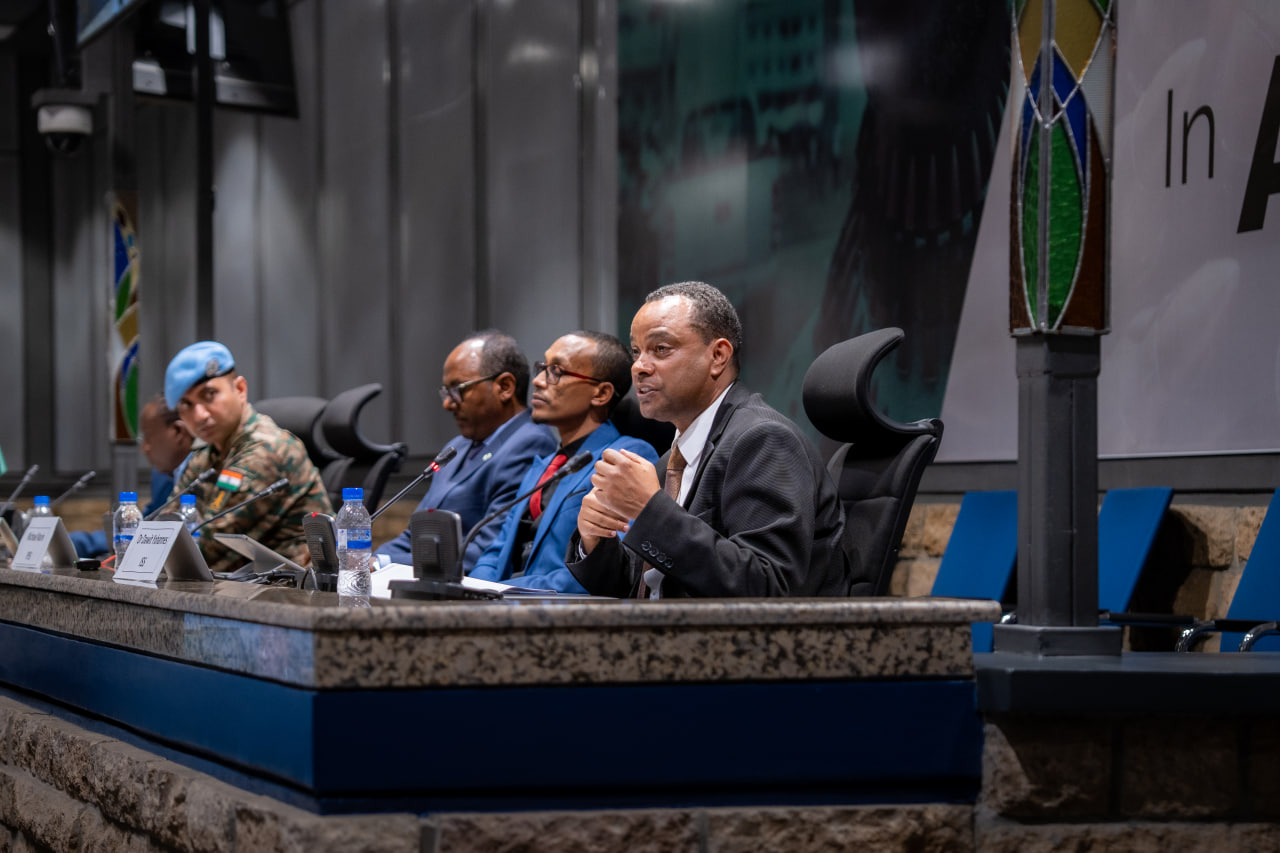
ADDIS ABABA, ETHIOPIA – As Africa marks the 78th International Day of UN Peacekeepers under the theme “Invest in Peace,” a panel of African Union, United Nations, and research experts delivers a blunt message: peace operations are facing rising demand, shrinking resources, and increasingly complex security threats. The question is no longer whether peacekeeping remains relevant. The question is whether institutions are prepared to adapt before the next crisis arrives.
The discussion, moderated by Meressa Kahsu Dessu (PhD), brings together officials from the African Union Commission (AUC), the United Nations Office to the African Union (UNOAU), the Institute for Peace and Security Studies (IPSS), and the Institute for Security Studies (ISS). Despite their different institutional perspectives, the panelists converge on one central argument: investing in peace requires more than deploying troops. It requires political commitment, sustainable financing, stronger partnerships, protection for peacekeepers, and meaningful investment in young people and women.
The Financing Problem No One Has Solved
For the African Union, the challenge remains straightforward: mandates often exceed resources.
Eustace Chiwomb, Head of Policy Evaluation and Training within the AU Peace Support Operations Division, argues that African peace operations continue to suffer from a mismatch between political ambition and financial reality. He points to recurring funding difficulties in Somalia and broader challenges facing the African Standby Force.
“We have had very wonderful plans but no finances to execute them,” Eustace says.
The African Union has spent more than two decades building continental peace and security mechanisms. Yet financing remains heavily dependent on external partners. While UN Security Council Resolution 2719 is expected to unlock more predictable support for AU-led peace operations, implementation remains incomplete.
Eustace notes that African states are simultaneously attempting to strengthen the AU Peace Fund to reduce dependence on donors. But he acknowledges that the continent is not there yet.
The implication is significant. As conflicts evolve from conventional warfare to include terrorism, extremism, cyber threats, and transnational instability, Africa’s peace architecture is being asked to do more with limited resources.
Why the UN-AU Partnership Matters More Than Ever
If financing is one challenge, coordination is another.
Colonel Rahul Sachan, Military Adviser at the United Nations Office to the African Union (UNOAU), argues that peace operations can no longer function through fragmented institutional approaches.
“The conflict dynamics these days are quite challenging. There is a need to have dynamic collaborations and partnerships,” Rahul says.
Rahul identifies three pillars for future cooperation: common political vision, complementarity of effort, and interoperability between the United Nations, African Union, Regional Economic Communities (RECs), and Regional Mechanisms (RMs).
The argument reflects a broader shift within peace operations. Rather than treating institutions as separate actors, the emerging model seeks integrated planning, joint benchmarks, information sharing, and coordinated transitions between missions.
Rahul warns that future missions will require stronger operational continuity, particularly during transitions such as those currently under discussion in Somalia.
His most notable recommendation goes beyond coordination.
“There is a time to graduate these partnerships from coordination mode to co-ownership mode,” Rahul says.
That statement captures a growing policy debate within African peace and security circles. As African institutions assume greater responsibility for managing conflicts on the continent, many analysts argue that partnership frameworks must evolve from donor-recipient arrangements toward genuinely shared ownership.
Africa’s Youngest Generation Is Already Building Peace
While much of the discussion focuses on institutions, Michael Masrie, Researcher at the Institute for Peace and Security Studies (IPSS), shifts attention to people.
Michael argues that the future of African peacebuilding depends on recognizing a demographic reality that institutions often overlook. Africa is the world’s youngest continent, yet young people and women remain underrepresented in peace and security decision-making processes.
Drawing from his experience managing peacebuilding initiatives in Ethiopia’s Amhara and Oromia regions, Michael describes how local actors often detect and prevent conflict long before formal institutions intervene.
“The next generation is not waiting to become peacebuilders. They already are,” Michael says.
His argument challenges conventional approaches to peacebuilding. Instead of treating youth and women as future stakeholders, Michael argues they should be recognized as current security actors.
He proposes four priorities: investment in peace education, direct funding for youth-led and women-led initiatives, support for technological innovation, and pathways into leadership positions.
Michael also warns that inclusion without resources produces limited results.
“Inclusion without investment is not empowerment. It is participation without power,” he says.
That distinction matters because many community-based peace initiatives operate with minimal funding despite demonstrating measurable impact in conflict prevention and social cohesion.
For Michael, investing in youth is not a symbolic exercise. It is a security strategy.
The Forgotten Frontline: Protecting Peacekeepers
Dawit Yohannes (PhD), Head of the Training for Peace Programme at the Institute for Security Studies (ISS), focuses on a dimension often overshadowed by strategic debates: the people deployed to implement peace.
Dawit argues that peacekeeping itself is at a crossroads. Demand for peace operations continues to rise in places such as Sudan, Somalia, and eastern Democratic Republic of Congo, even as deployment levels have declined over the past decade.
“Peacekeeping is at a crossroads,” Dawit says.
He believes discussions about adaptation are too often dominated by financing and geopolitics while overlooking the welfare of peacekeepers themselves.
“The safety and security and recognition of their sacrifices should not be an afterthought,” Dawit says.
His recommendations are practical. Peace operations need better evidence-based assessments of threats, stronger accountability for attacks targeting peacekeepers, improved troop preparation, and expanded mental health support.
Dawit pays particular attention to psychological trauma, arguing that support mechanisms often end when deployments conclude, despite long-term consequences for personnel.
His broader point is that protecting peacekeepers is not merely a moral obligation. It directly affects mission effectiveness and institutional credibility.
Beyond Peacekeeping
Taken together, the panel’s message is clear.
Africa’s peace and security debate is moving beyond traditional questions of troop numbers and mandates. Financing, partnerships, youth leadership, digital innovation, local ownership, and peacekeeper welfare are becoming central to how peace operations are designed and evaluated.
The discussion also reveals a growing consensus that prevention remains cheaper than response. Yet prevention requires sustained investment long before violence erupts.
As governments, regional organizations, and international partners debate the future of peace operations, the challenge identified by the panel is ultimately political. Institutions must decide whether they are willing to invest in the people, systems, and partnerships capable of preventing tomorrow’s conflicts.
Or, as Michael puts it, “Peace is ultimately built by people.”
The future of peacekeeping may depend on whether policymakers act on that insight before the next crisis demands a far more expensive response.