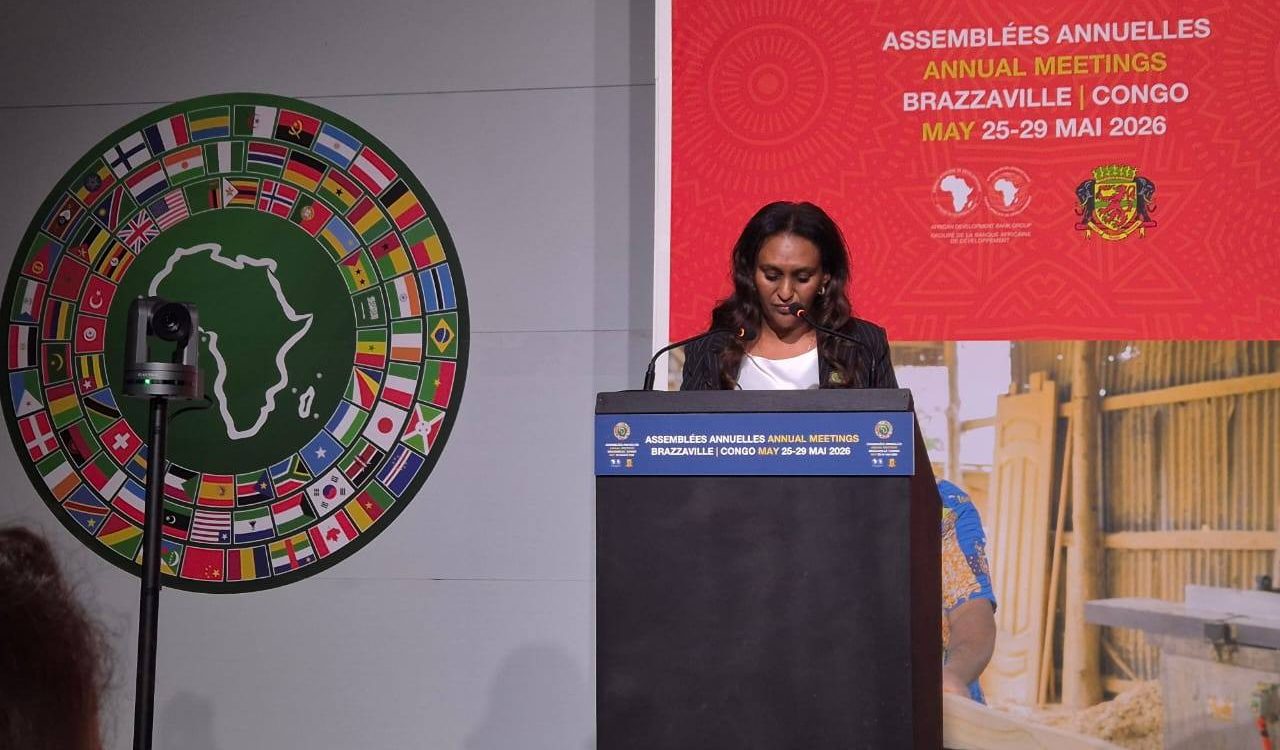
 BRAZZAVILLE – Ethiopia is positioning COP32 as a platform for implementation-driven climate finance and large-scale green investment, as African policymakers and development finance institutions push for a more coordinated continental agenda ahead of the 2027 summit to be hosted in Addis Ababa.
Speaking at a high-level dialogue on “Africa Leading Climate Action: Investment, Partnerships, and the Road to COP32” in Brazzaville, Semereta Sewasew, Ethiopia’s state minister of finance, says Africa is seeking a decisive shift from fragmented climate commitments toward integrated financing systems capable of delivering measurable economic transformation.
The dialogue is convened by the African Development Bank in collaboration with the Climate Investment Funds and the Fund for Responding to Loss and Damage, bringing together ministers, development banks, private investors and climate finance institutions to align priorities ahead of COP32.
Ethiopia links climate finance to structural transformation
Semereta frames climate finance not as a parallel environmental agenda, but as a core development financing issue tied directly to food systems, energy access, industrialisation and economic resilience.
“Climate finance must be treated as development finance,” she says, pointing to Ethiopia’s investments in renewable energy, resilient agriculture, landscape restoration and sustainable land management under its Climate Resilient Green Economy strategy.
She argues that African countries are increasingly approaching global climate negotiations from a position of institutional agency rather than dependency.
“Africa is not approaching COP32 as a passive recipient of support,” she says. “It is approaching as a co-architect of a more equitable and effective climate finance architecture.”
The remarks position Ethiopia’s hosting of COP32 as part of a broader attempt to elevate Africa’s role in shaping the implementation phase of global climate governance.
Development banks push implementation over pledges
A central theme emerging from the Brazzaville discussions is the growing frustration among African policymakers with slow delivery mechanisms and fragmented climate financing structures.
Kevin Kariuki, vice president of the African Development Bank, calls for accelerated infrastructure investment capable of producing visible gains in resilience, energy access and sustainable growth.
Participants repeatedly stress the need to move beyond negotiation cycles and scale investment-ready projects with clearer financing pipelines and institutional coordination.
The discussions also focus heavily on mobilising private capital alongside concessional and multilateral financing.
Tariye Gbadegesin, chief executive of the Climate Investment Funds, says catalytic public finance and stronger partnerships are essential to unlocking larger flows of commercial investment into African climate projects.
She highlights the importance of country-led investment platforms capable of moving projects from concept stages into execution.
Loss and damage financing gains urgency
The issue of loss and damage financing also features prominently during the dialogue as vulnerable African economies continue facing escalating climate shocks.
Ibrahima Cheikh Diong, executive director of the Fund for Responding to Loss and Damage, says financing systems must become faster, more accessible and more responsive to frontline countries experiencing climate-related disruptions.
The intervention reflects wider African concerns that global climate finance systems remain too slow and procedurally fragmented to respond effectively to worsening environmental and economic pressures.
Participants argue that implementation credibility will increasingly define the political significance of future climate summits.
COP32 framed as Africa’s implementation summit
The broader discussions position COP32 not simply as another negotiation forum, but as a potential transition point from climate diplomacy toward execution-focused delivery systems.
A high-level panel involving Niguss Aklilu, chief executive of COP32, alongside representatives from the UK, Germany and the United Nations Economic Commission for Africa (UNECA), reinforces calls for integrated investment platforms and stronger coordination among development finance institutions.
Participants emphasise that fragmented approaches to climate financing are increasingly insufficient for the scale of Africa’s infrastructure, adaptation and resilience needs.
Instead, discussions centre on building nationally aligned systems capable of mobilising finance at scale while improving implementation efficiency and private sector participation.
The dialogue closes with growing consensus that Africa intends to use COP32 to reposition itself not only as a priority region for climate action, but as a driver of scalable investment models and practical implementation frameworks within the evolving global climate finance system.